
Clive Barker’s DREAD
Why this short horror story still lingers in my subconscious 34 years later ...and what I’ve done about it.

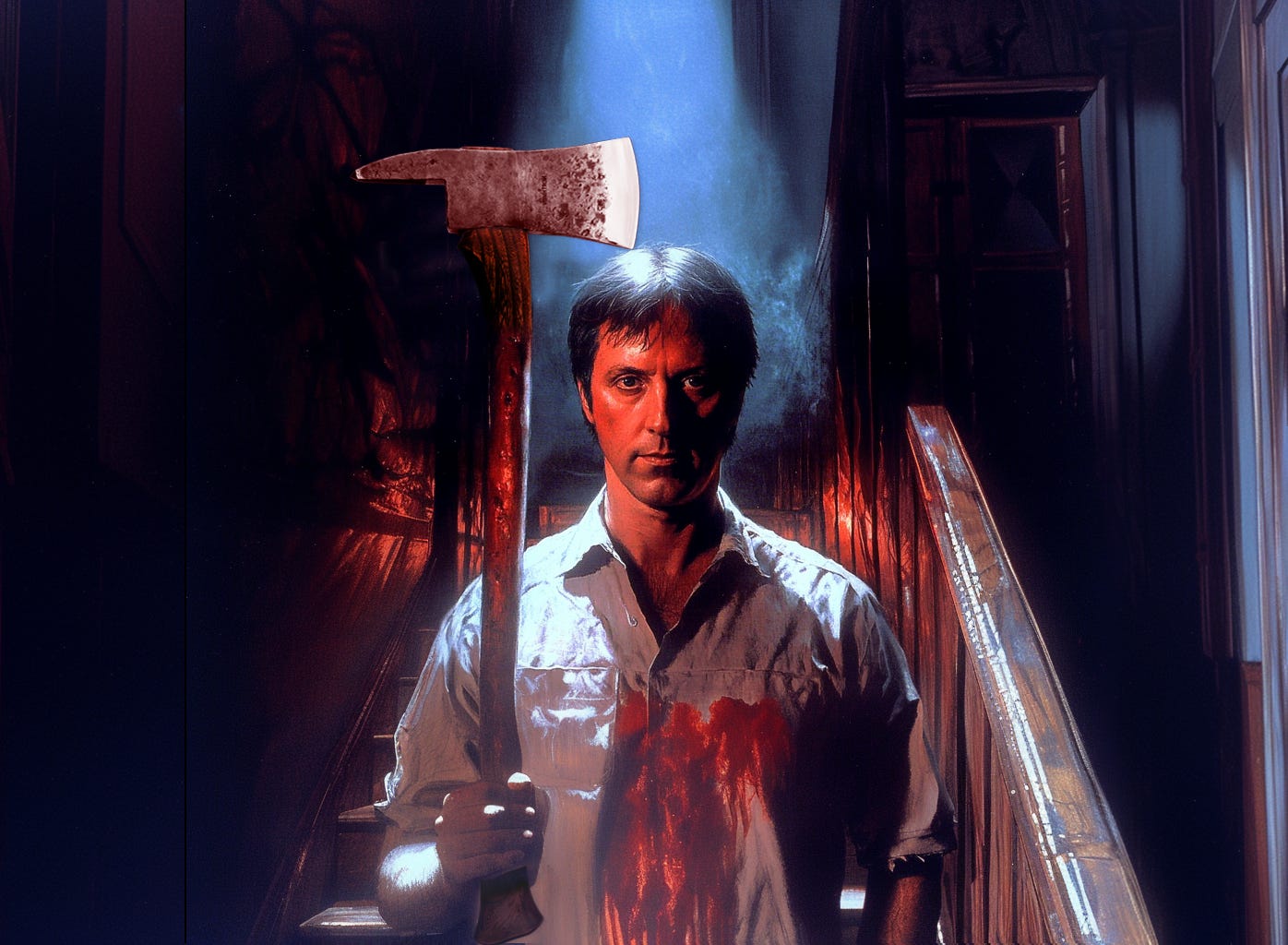
What is Dread?
Dread, for anyone who doesn’t know, is a short story written by the renowned British horror writer, artist and filmmaker Clive Barker, published in 1984 as part of three volumes of short horror stories titled Books Of Blood. Dread was the first story that appeared in volume two.
Dread tells the story of Quaid, an intelligent, eccentric and slightly unnerving university student, older than his peers, who is obsessed with other people’s dread. He befriends two of his philosophy classmates, Steven Grace and Cheryl Fromm, intent on finding out their fears, so that he can lure them into a trap, forcing them to confront their own dread, in the hope he will learn how to overcome his own.
Steve is initially drawn in by Quaid’s unique philosophy, until his focus shifts to Cheryl and her vegetarianism. Initially Cheryl considers Quaid a creep and a charlatan, yet to Steven’s utter disbelief, Quaid somehow manages to brainwash her into idolising him, spending all of their free time together. Steve feels betrayed and rejected, particularly as he is attracted to Cheryl, but he is also disturbed and scared by Quaid’s behaviour, realising he has already confessed his own unique dread to Quaid.
As a young boy, Steve was hit by a car and suffered temporary hearing loss and tinnitus as a result. He spent many lonely nights crying in the dark, frightened of the silence and isolation. Realising Quaid knows all of this, Steve feels exposed and vulnerable. He decides to skip his classes for the rest of the term, just so he can avoid Quaid.
Returning from a long summer break at home, Steve feels revitalised, ready for a fresh start, until Quaid corners him in the university library. He invites Steve to come to his house to pick up a copy of the philosophy book he’s looking for, eager to show Steve his ‘holiday snaps.’
That evening, drunk and stoned, Steve and Quaid laugh and joke as if they were still the best of friends. Quaid then reveals that Cheryl spent most of the summer with him, locked in a room upstairs with a slab of cooked meat. Steven stops laughing. Quaid shows him photos of his experiment, of Cheryl’s initial resistance, of the meat going off, of her slow psychological demise, until she eventually breaks, eating the now rancid meat down to the bone. Steve is horrified and outraged, but before he can do anything, Quaid smothers him with chloroform.
Steve wakes up in complete darkness, on a grill in some kind of industrial shaft. He has a contraption on his head that clamps plugs, tightly into his ears. Quaid is simulating Steve’s childhood dread, but just like the experiment on Cheryl, he fails to learn anything useful from the experiment, leaving Steven’s mind broken, stuck in a traumatic childhood state.
Knocking Steven out again with chloroform, Quaid dumps him in an alley, where he’s eventually discovered by a policeman. Thinking Steven’s high on drugs, the policeman takes him to a local men’s hostel. There he is washed and reclothed in a mismatch of colourful second-hand clothing, before being given a bed for the night.
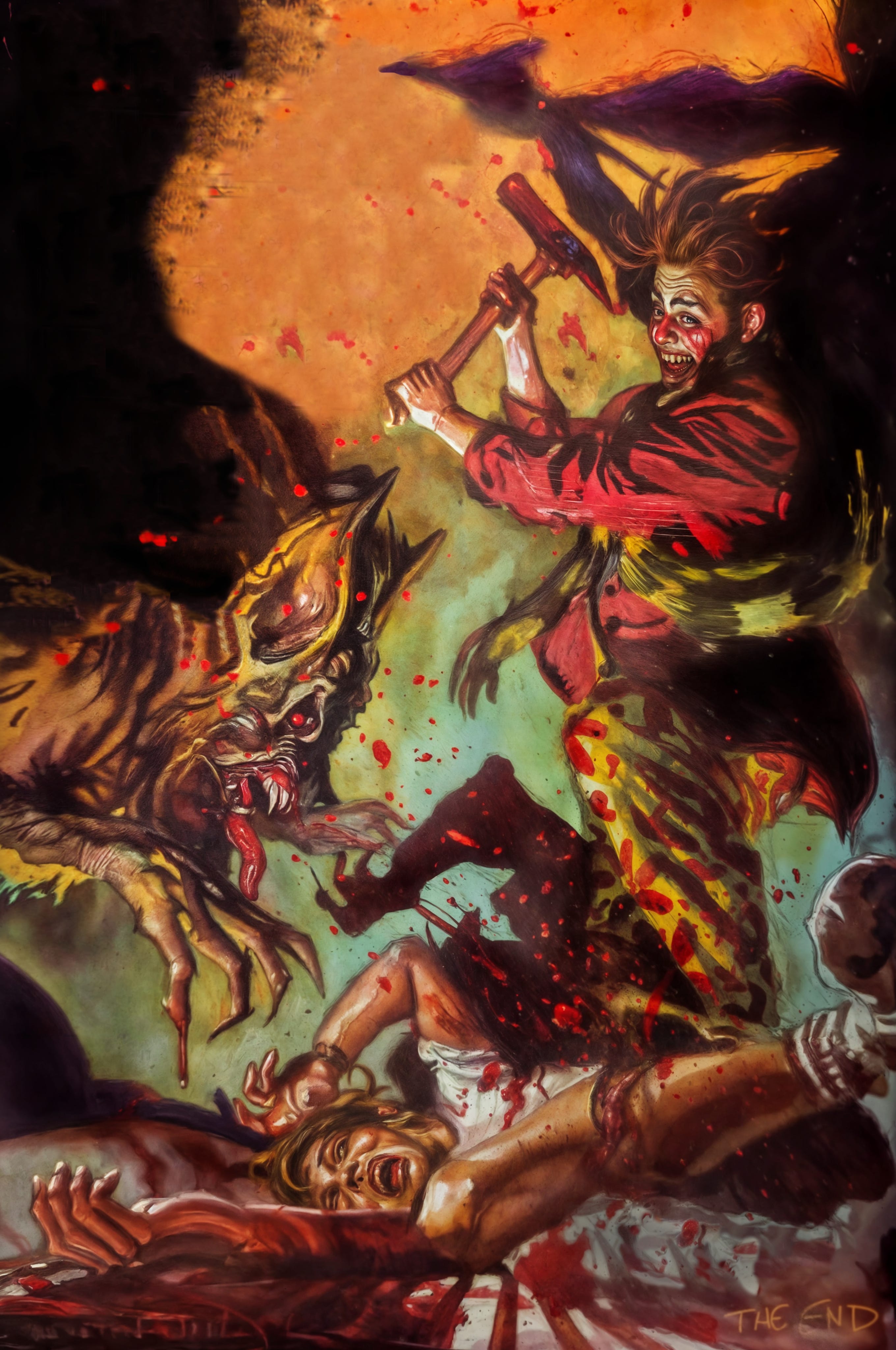
In the early hours, Quaid wakes violently from a reoccurring nightmare - an axe wielding clown who breaks into his house and slaughters him. Quaid has never endured this dream twice in one night before and has to check the house, to make sure it was definitely just a dream.
Around the same time, a fight breaks out in the hostel, waking Steven. The incident triggers a succession of flashbacks, that leads Steven’s broken mind back to Quaid and all the terrible things he has done. While the warden tries to control the fight, Steve slips away unnoticed. On his way out, he passes a fire axe and hose on a wall. He stops, drawn to the axe.
Quaid jumps awake again, thinking he heard his front door being forced open. He listens intently. Maybe he was just dreaming again? But then he hears a creak at the foot of the stairs, then another on the next step, followed by another and another, until a dark figure emerges, pausing half-way up the stairs. By the way he is dressed, he certainly looks like the clown from his dreams. Steven slowly raises the axe above his head and lunges into the room, swinging the axe down towards Quaid, who twists his body to try and avoid the blow. The axe slices through his triceps. Quaid screams with pain, begging Steven to stop, but Steven cannot hear him and continues to chop at Quaid’s body parts, again and again and again.
Quaid finally learns there are things worse in life than dread, there is pain without hope of healing and there are some dreams that do come true.
Discovering the imagination of Clive Barker
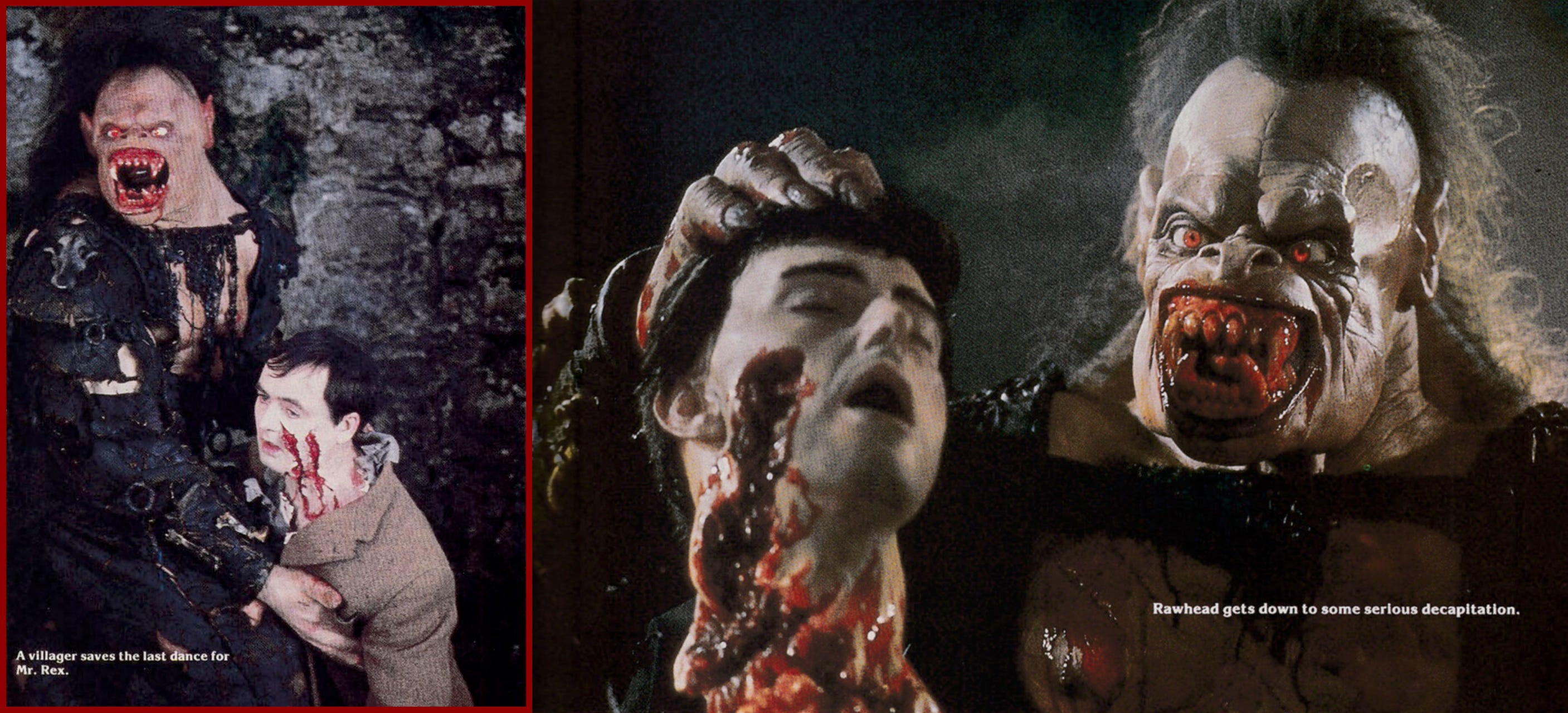
I had gotten into horror films in my late teens, having already watched the screen adaptations of Clive Barker’s Rawhead Rex (1986) and Hellraiser (1987) on VHS, via my local video rental store.
I got to learn about such films from the reviews and featured articles found in Fangoria magazine, and still remember the tight feeling in my stomach after I turned the page to reveal a demonic image of Rawhead Rex holding a mauled villager. Sadly the film turned out to be a pretty awful B-movie, which I later learned drove Clive Barker to insist on directing his next screen adaptation - Hellraiser.
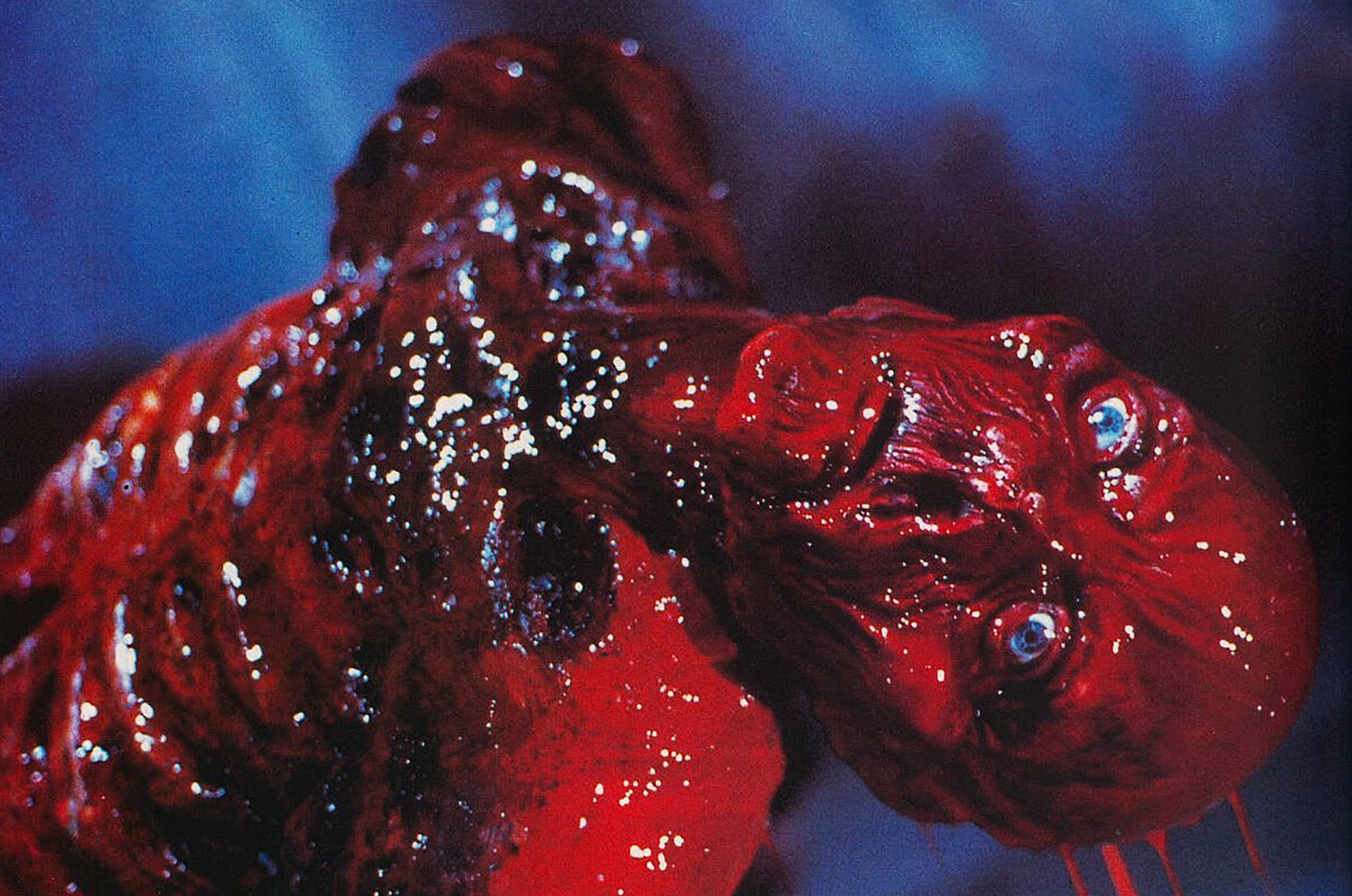
The imagery and world-building in Hellraiser was just incredible, stimulating my imagination in ways I had never contemplated before - the designs and SFX make-up of the Cenobites captivated me psychologically as well as viscerally. I had never seen anything quite like it.
I remember watching it on a Friday night with my old school friend Karen, who was so grossed out by the resurrection sequence of Frank, she could barely watch. It was utterly grotesque, yet (for me) completely entrancing too.
In fact, one of the most palpable dreams I ever had, was coming face to face with the Cenobites on a rural track beside an old shed. Pinhead appeared from behind it, blocking my path. His fellow Cenobites surrounded me, as he proceeded to curse me using some kind of devil language (that I somehow understood), presumably sending my soul to hell, as my whole body was sucked through the grill of the roadside drain. What was particularly unsettling, was that I could feel the grill being pulled through my body, which was the moment I woke up.
The resurrection sequence used an array of really clever special effect techniques by the now legendary Bob Keen, to create a reanimation that I think has stood the test of time. Like the Skeletons in Jason and the Argonauts, there’s just something in the way real physical creations can be manipulated in a very unnatural way, that resonates deep into your psyche - something I believe CGI has failed to emulate.
As for Clive Barker’s books, I regrettably had never read any. I wasn’t a confident reader when I was young, I found reading difficult and slow, which I guess is why I loved movies so much. If I did read, it tended to be a novelisation of a film. Horror fiction was just not on my radar. I am now an avid reader, though mostly non-fiction, but I hope to read at least one of his fantasy horror classics before I die.
The only reason I came to read Dread, was because in 1991, my film mentor at art college, Paul Buck, had suggested I find a book of short stories and pick one to adapt for my next filmmaking project.
I went down to the Maidstone market one Tuesday morning and rummaging through a second-hand book stall, pulled out a battered copy of Books of Blood Vol. II. I scanned the cover with curiosity and decided to purchase it. When I got home, I started reading a few pages of the first story Dread, but found I couldn’t put it down.
It was only thirty or so pages, with a simple yet gripping story, featuring just three characters, set in the present day, using locations that were not too difficult to find. Best of all though, I’d get the chance to create some bloody special make-up effects for the ending (which I already had some practice of) - In practical terms, this was a perfect story for me to turn into a film.
What hooked me on a deeper level?
Being so young and inexperienced at the time, it’s impossible to know with any certainty what the deeper aspects of the story were that drew me in, as it was very much subconscious, but there was one obvious one.
Somewhere between 10 and 12 years-old, I developed a genuine dread of my own mortality. Not so much a fear of death, but a fear of not being alive. I’m guessing it stemmed subconsciously from either my first pet cat having to be put down, or more than likely, when my Granny unexpectedly died at 67 years old.
When I contemplated my mortality for too long, I’d suffer little panic attacks in my chest and feel sick in my stomach over the fact that I was going to die one day - knowing there was nothing I could do to prevent it.
I remember lying on my bed, wiggling my fingers in front of my face, imagining just my skeleton fingers wiggling back at me. I’d stare at myself in the mirror and imagine my inanimate skull underneath the flesh and muscle of my youthful, highly expressive and recognisable face, knowing that if my decomposed remains were ever to be dug up in the future, my skull would look indistinguishable from any other human skull (except perhaps for an exceptionally thick nose bone).
The only saving grace was that I was still young and had the rest of my life to figure out a way to overcome such fear. For now though, to ease the panic and dread, I would just push it back into the subconscious recess of my mind, until the next time something pulled it back to the forefront again.
Adapting Dread into a screenplay and making it into a film was probably my first attempt at ‘touching the beast’ (this is not a euphemism; it is in fact a line from Dread) - confronting and exploring my own dread without having to experience the panic that came from more explicit reflection.
In addition, the psychology and philosophy behind the story and of Quaid’s prolonged bloody death, was equally macabre and fascinating to me. Many lines in the book opened my mind to deeper thoughts and ideas I’d never contemplated before.
What is unique about the character of Quaid?
Not long after the Hungerford killings in the summer of 1987, Clive Barker was a guest on an episode of BBC2’s Open to Questions, where he defends his writing against the accusation that his stories might incite violence.
He suggested that real killers like Michael Ryan, were more likely to be influenced by films like Rambo than Hellraiser, but that he did think that glorifying ‘man in the mask’ horror movies (like Halloween and Friday the 13th), that kill vulnerable teenagers one-by-one with machetes or knives, was harmful.
As a result, he said he did not write ‘psychos on the loose’ stories. He preferred to use fantasy or supernatural horror as a metaphor to get to darker truths of the human psyche. Except, he said, for one exception - DREAD.
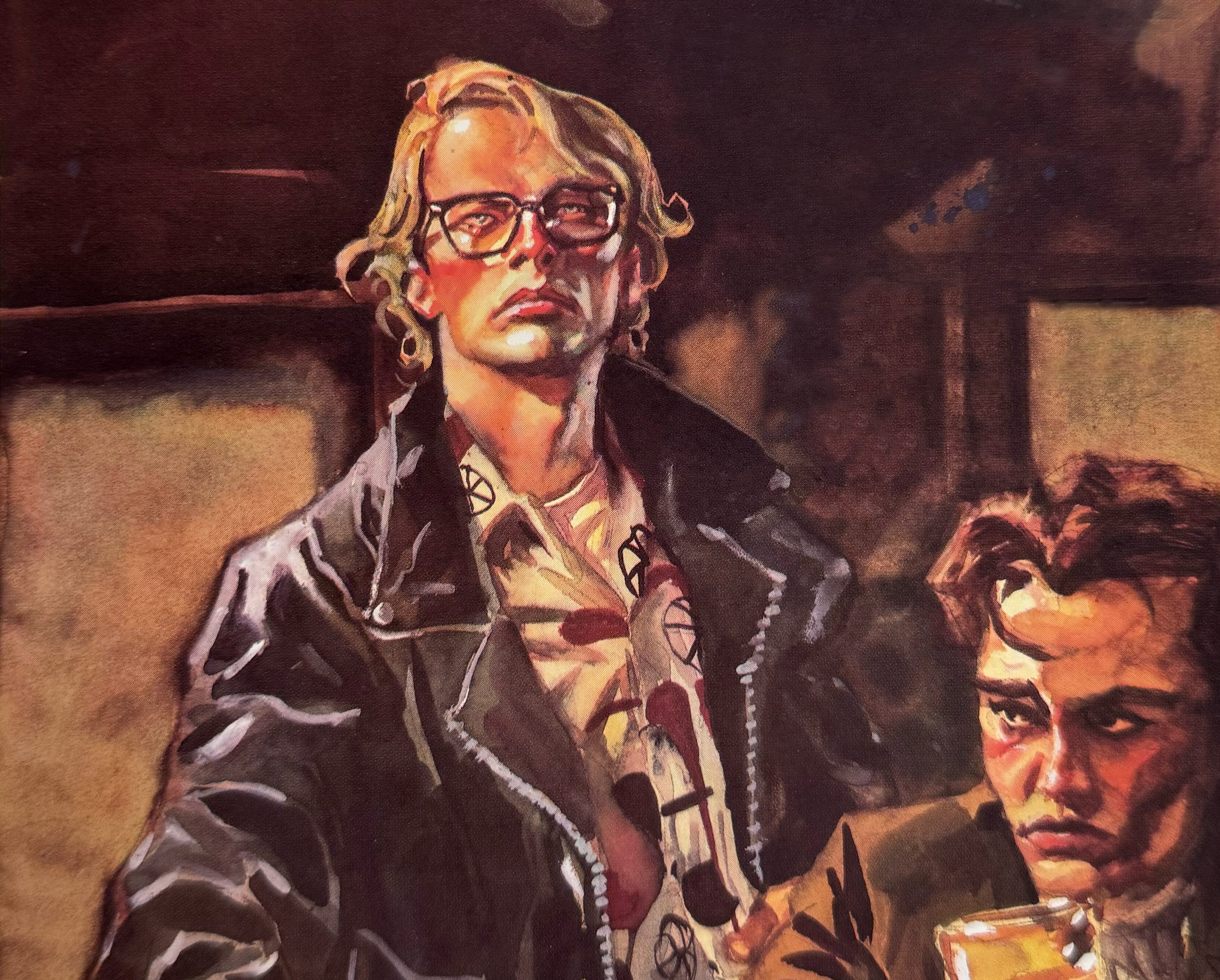
For me though, Quaid is not your stereotypical ‘psycho on the loose.’ Those films focused on what has since become well-worn horror tropes, cheap scares and the use of excessive, unrealistic blood and gore.
Michael Myers, Leatherface, Jason Voorhees and Freddy Kruger commit gruesome and explicit killings and have an inhuman ability to return from the dead. Even Hannibal Lecter’s cannibalism, despite he himself being a far more believable character, is still asking us to suspend our disbelief. The character of Quaid however, is very much grounded in reality and doesn’t actually kill anyone (even though he is clearly capable of it). What makes him so formidable is exactly how human he is.
Quaid is someone you can imagine you might have the misfortune to meet in real life. He scares you by how easily he can turn your psyche against your will. His psychopathy is not to kill, it is primarily to manipulate and control and is the reason he (and thus the story) is so captivating.
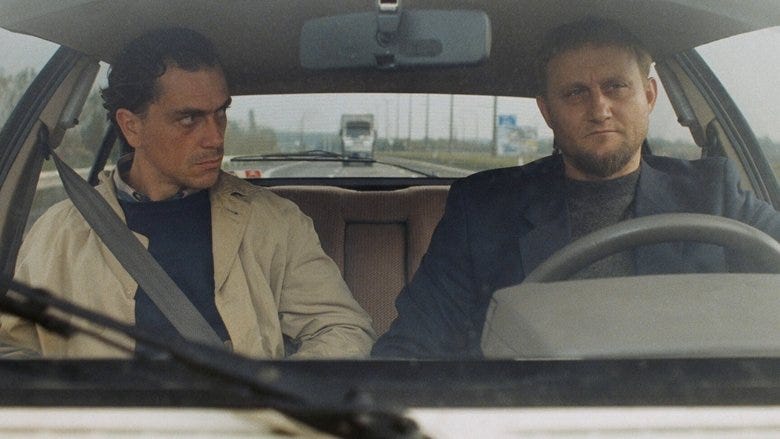
Interestingly, I must have a thirst for this kind of character, as he shares similar traits to the brilliantly conceived antagonists from two of my all-time favourite films. The first being Raymond Lemorne - a truly dark, twisted, human being from the original 1988 Belgian psychological thriller - The Vanishing. He and Quaid both have a cold, calculating desire to find the perfect victim in which to test their own limits.
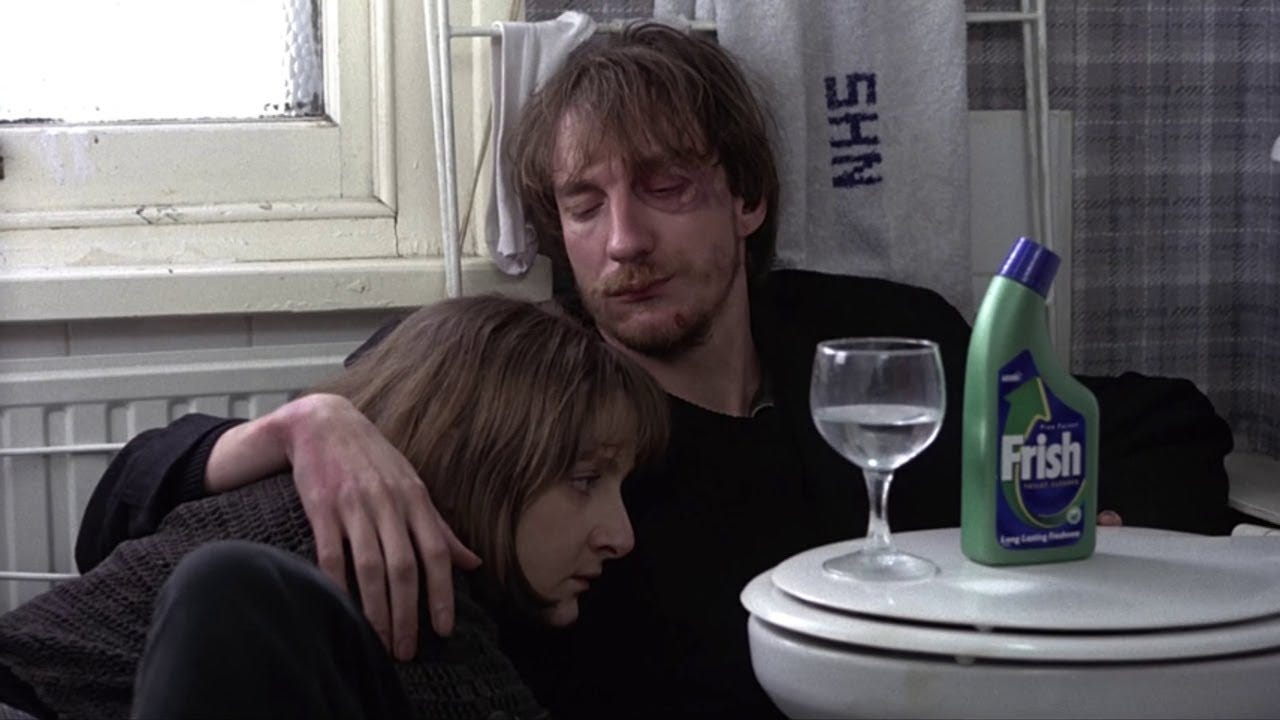
Then there is Johnny Fletcher (David Thewlis) from Mike Leigh’s Naked. More self-destructive anti-hero than psychopathic villain, he is also a studious philosopher who, frustrated by the ease in which fools seem drawn to him, preys on their vulnerabilities out of a deranged self-destructive spite.
Casting for my 90’s adaptation of DREAD
A few years before I started on Dread, I made a sequel to Aliens with some of my fellow school friends, one of which happened to be Steven Payne. His younger brother Anthony, wanted to get into acting and had begged me to cast him in my next film, so I did, giving him the role of Steven Grace. I was excited by the fact that Ant would take it more seriously than my friends, who had really just helped me out for a laugh.
Ant was a member of the Old Bric Youth Theatre and had a friend there called Paul Hardy, who was a few years older than him and thought he would make a good Quaid. I don’t remember meeting Paul for the first time, but I do remember being excited by his performance in the first pub scenes we shot. He looked very different than the average Maidstonian, and his slight Scottish accent added some flavour to his dialogue, which he delivered with an authentic menace.
I had briefly worked with Wendy Clements at Dolcis shoe shop and thought she was absolutely stunning - perfect for Cheryl Fromm. Unfortunately, I didn’t have her number, so I ended up asking a mutual friend to find out if she would be interested in playing the part. Incredibly she said yes and despite being a little self-conscious, once she got over the initial giggles, she gave it her all.
After I cast Wendy, I decided to change her character’s name to Wendy Fromm instead of Cheryl Fromm, as my sister was called Cheryl and I found it too distracting.
Filming my 90’s adaptation of DREAD
I have no recollection of the exact dates we filmed each of the scenes for Dread, or in what order. The only physical evidence is an accidental time stamp on some of the footage that’s dated the 28th March 1991. I’m guessing we could have started shooting early 1991 and may well have shot the very last scene (Steven in the shaft) in Easter, or even as late as the summer of 1992.
The three pub scenes were shot in the Motley Hall pub, up the Loose Road in Maidstone. We got access because Wendy used to work there - In fact I think the young guy who serves Quaid at the bar was her boyfriend at the time. These long dialogue scenes must have been one of the first shoots we did, as the performances and the camera coverage are a bit ropey at times, suggesting we were still finding our feet.
My method of coverage back then, was to shoot from one angle until one of them fluffed their lines, then I’d pick it up again from another angle and so on. Trying to remember so much dialogue off-the-cuff, meant we had to resort to a few tricks. In many cases the actors would read the dialogue from a script either just off-camera or laid out flat on the bar, in which case I’d get a low angle shot on them, so the script couldn’t be seen - I think Paul even wrote prompts on his cigarette packet!
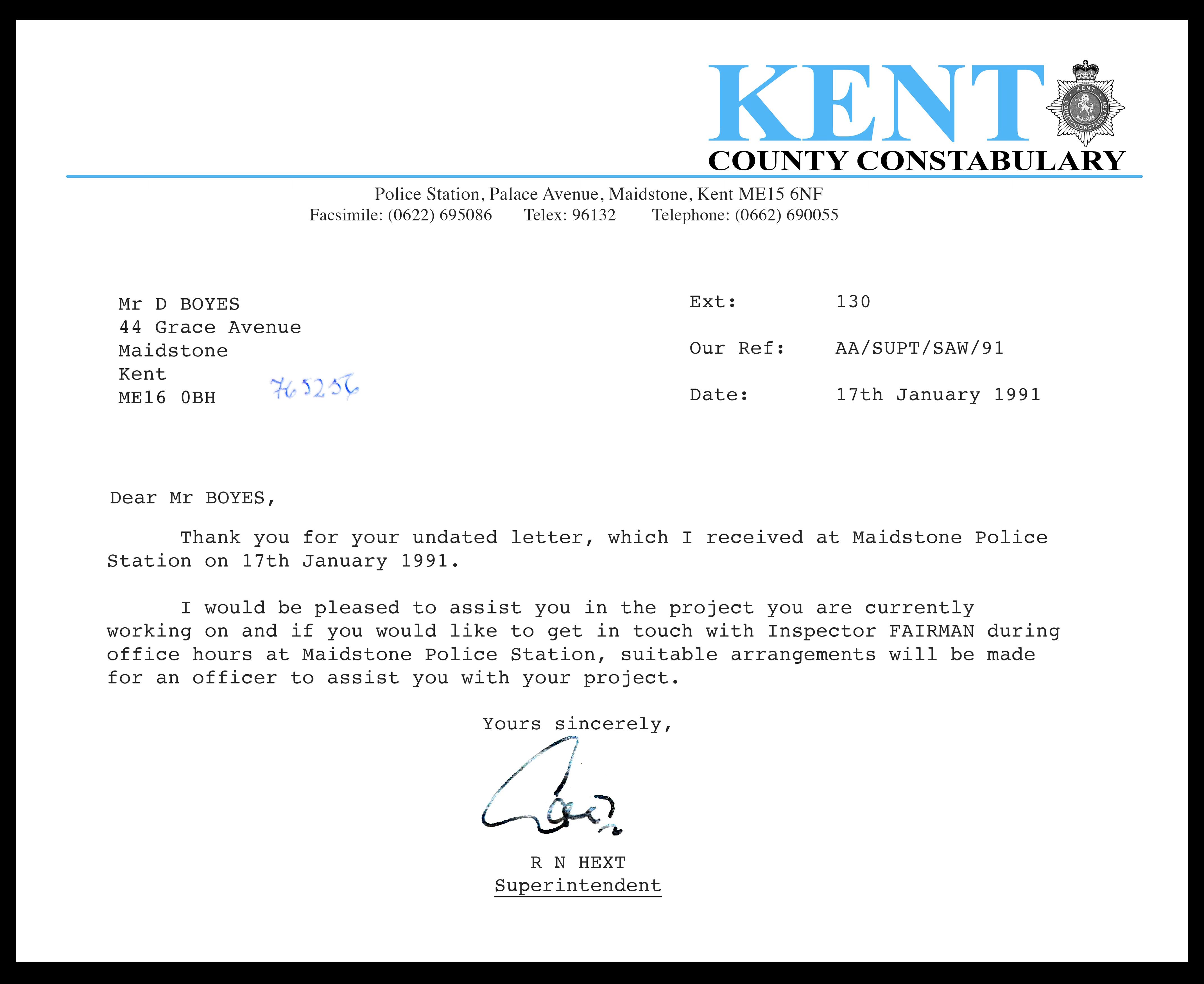
One of the earlier scenes I shot, required a policeman, so I decided to write a letter to my local police station in Maidstone, asking if I could get permission to have a police officer for a couple of hours. Incredibly, Super Intendant Hext authorised it, asking me to get in contact with PC Fairman to figure out the details. They asked to have a copy of the scene to review and made me omit the part where the policeman punches Steven in the stomach (which was fair enough).
In return they gave me PC Wardle 756 and a police van, which added loads to the production value. I milked the scene for as much footage as I could get. PC Wardle even offered to turn the blue flashing light on and have the police radio turned up inside the van, which all added to the authenticity. I was very pleased.
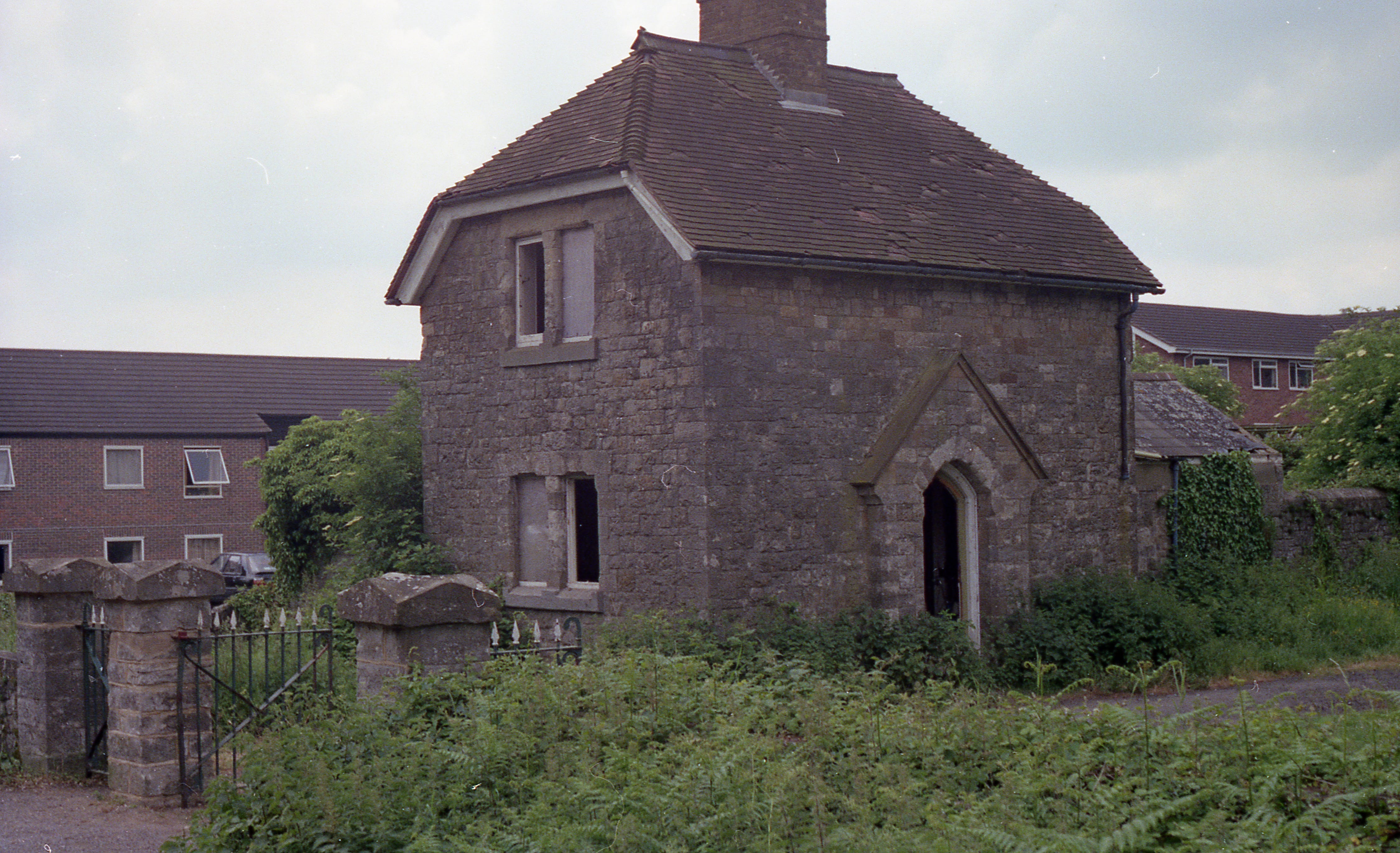
The derelict stone brick house we used for Quaid’s house used to be home to the Barming Psychiatric Hospital’s vicar. It was situated behind the student nurse’s accommodation at the end of Oak Apple Lane, next to a small chapel. A long time ago, it had once been used to hold modest funeral services for psychiatric patients and staff who had died at the hospital.
When I first discovered the building, the only way of getting inside it was to lift out a heavy metal grill just to the side of the main front door. I could then squeeze my body through the small rectangle space, until I came out under the basement stairs. I had to then feel my way in the dark, back up to the ground floor. I could then open the front door from the inside, letting everyone else in. The basement was full of years’ worth of cobwebs, seemingly made from one huge spider down there, who must have shed its skin more times than an alien.

Although the house was derelict, it was not entirely abandoned. In the living room there was evidence of someone squatting there, though it would be several more visits before I would encounter him. On that occasion, I was on my own, climbing through a small window near the bottom of the stairwell. It was a new found point of entry, easier to get through and less frightening than squeezing blindly down into the basement. As I clambered in, an alarmed figure of a man appeared out of the dark, scaring the living daylights out of me. I explained to him that I was using the house as a location for a film I was making and assured him I would not disturb him or his camp. He seemed perfectly okay with that.
I later fitted a bolt and padlock to Quaid’s bedroom door upstairs, so I could slowly bring over props and things to dress the set, without worrying about them getting stolen or vandalised.
As there was no electricity in the house, I used my dad’s petrol generator to power a floodlight and various lightbulbs on long lengths of cable, in which to light each room. You may notice in some of the shots, the light is ‘wowing’ as the generator struggled to maintain a constant current.
We did our best to reduce the noise of the generator, by keeping it down in the basement, but it was still prominent in the audio. This meant I’d eventually have to dub all the dialogue and rebuild the soundtrack from scratch. Back in 1991, this was not an easy thing to do.
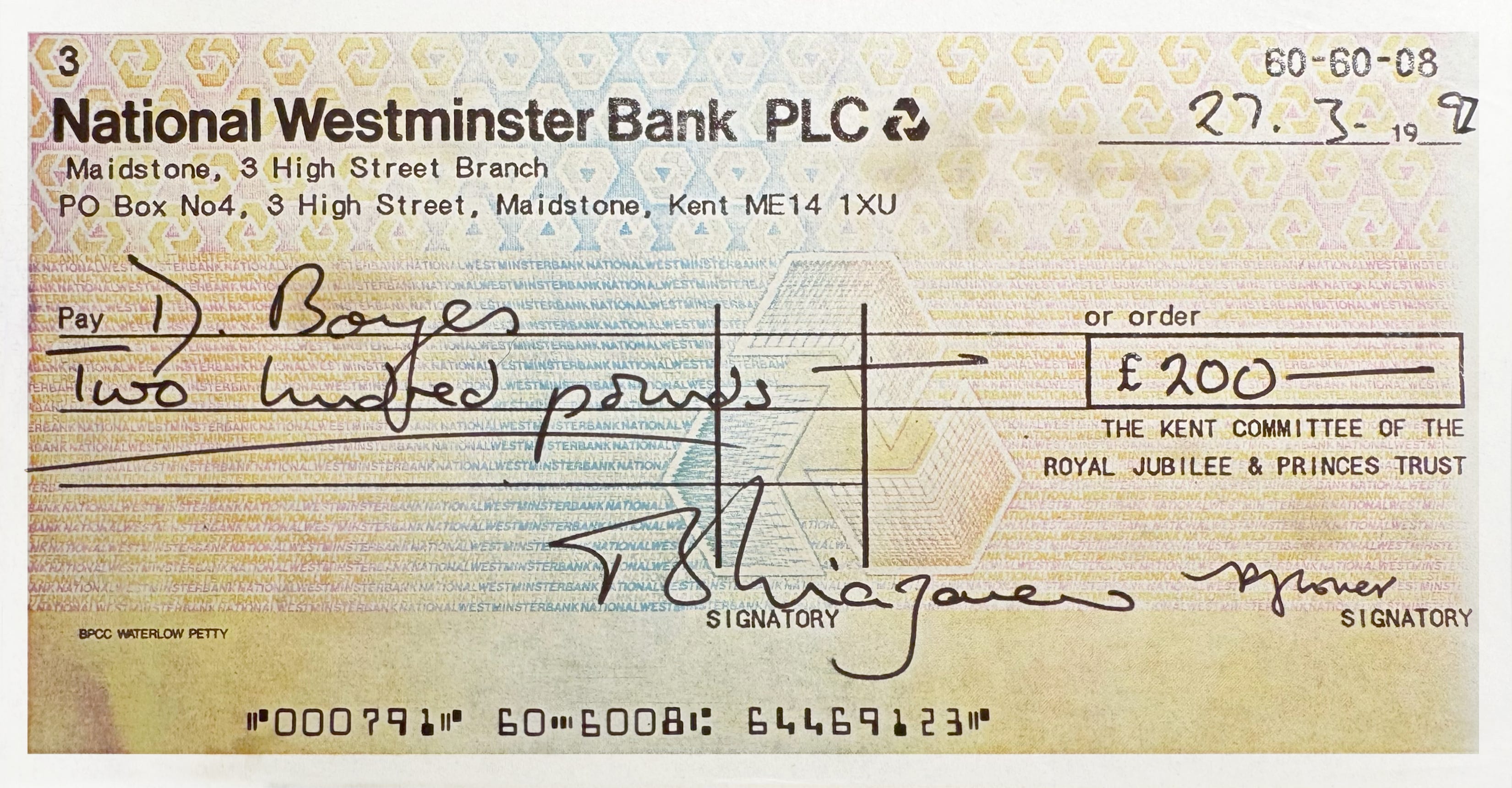
My solution was to ask The Princes Trust to fund me £200 to buy a professional SONY Walkman and microphone which, to my surprise and delight, they did. I had no clue how I was actually going to get any recordings off the Walkman and into a VHS edit, but just owning something ‘professional’ stopped me worrying. Regrettably, I don’t think I ever did record a single bit of dialogue for this film on that machine, as I never reached the post-production stage.
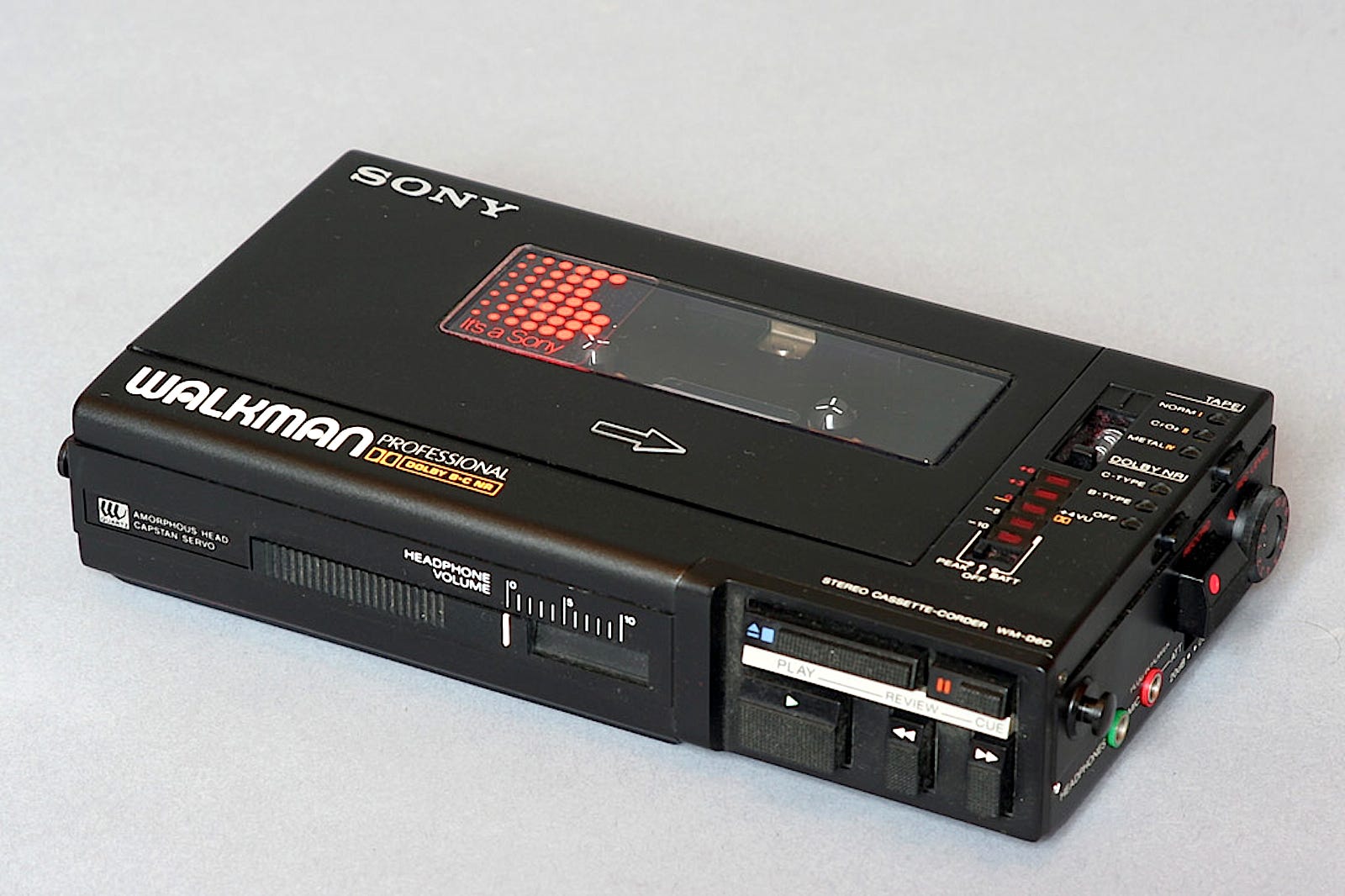
It didn’t go to waste though. Two years later, when I had to reshoot a 400ft roll’s worth of footage for my first 16mm short film, the batteries in the Nagra reel-to-reel sound recorder we hired, failed to charge overnight, so I used my Walkman Pro instead, which really saved my bacon. Sadly, when I went to study for my degree up in Newcastle, I accidentally dropped it down a whole flight of stairs and broke it. Ironically, I was moving it out of the communal kitchen in case it got damaged.
In my year-out between college courses, I worked part-time at Waitrose on the meat counter. With my boss’s permission I began collecting all the excess blood from the vacuum sealed packets of lamb’s liver, so that I could use it to splatter over the walls for Quaid’s bloody death. I must have collected half a dozen pints worth in all. The beef joint Wendy contends with, also came from Waitrose (with my staff discount). I had to buy two joints in the end, as we shot Wendy, locked in the spare room, over two sessions that were several weeks apart.
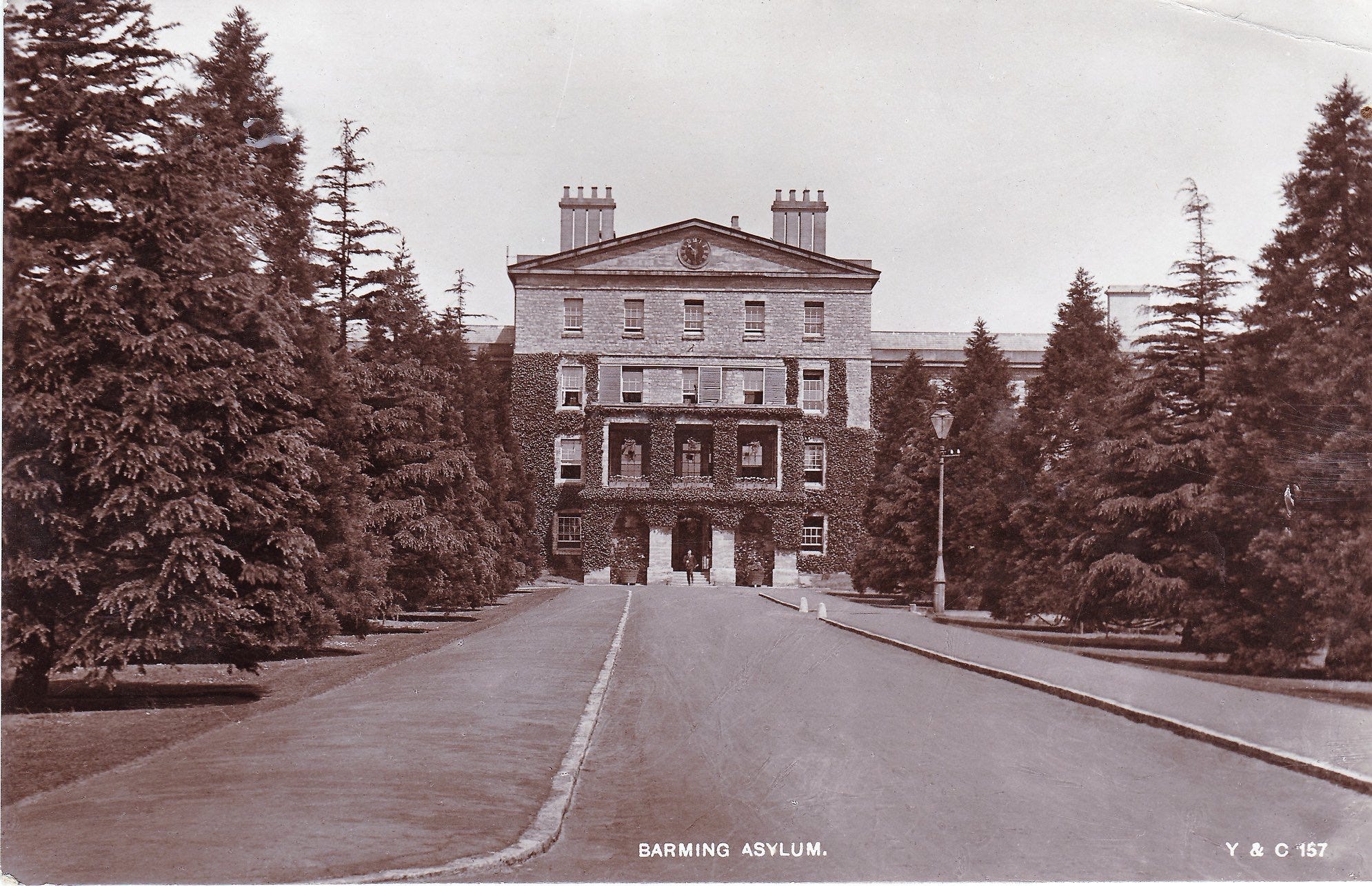
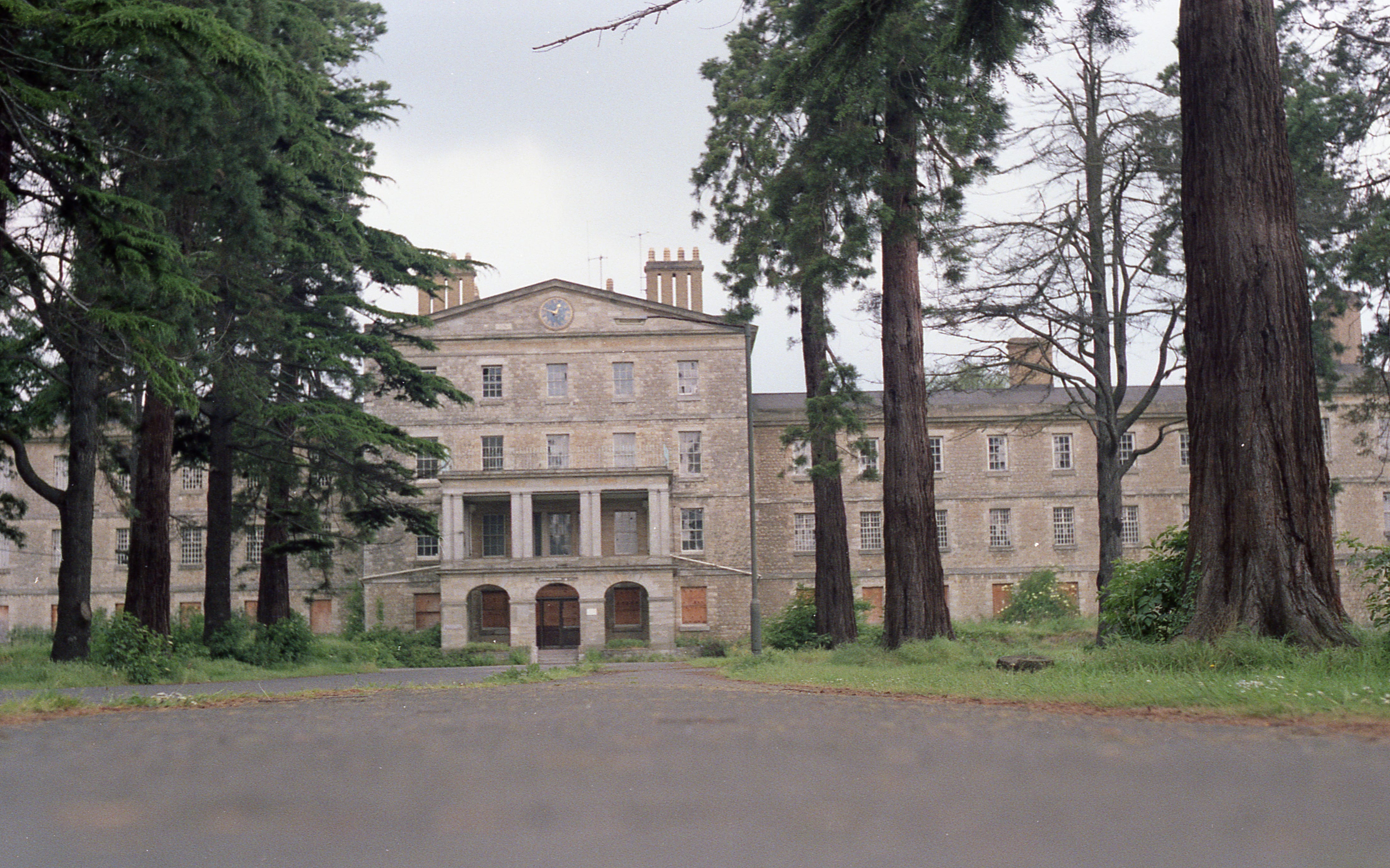
For the men’s hostel location, I used a ward in the recently abandoned Barming Psychiatric Hospital (the result of Thatcher’s infamous ‘care in the community’). I had managed to find a secret way into the boarded-up building where someone else had already forced entry, but quickly realised the building was patrolled by security guards with Alsatians. Now I’m aware that many empty buildings have warning stickers that say ‘Dogs on patrol’ to ward off vandals and mischievous teenagers, but these dogs were real - I saw them!
I realised I couldn’t just sneak in there and film what I needed without the risk of being caught, so I went into the Maidstone Hospital next door and asked reception who I needed permission from to film in there. They directed me to their head porter, Reg Walker, who took me for a tour around the abandoned building. I explained exactly what I wanted to do and he seemed happy to oblige, making sure the security team (and their dogs) knew when I was going to be there. I agreed some dates with him to do a lighting test recce, to dress the set and to finally shoot. On each visit he gave me a skeleton key that could open every door in the vast series of buildings and then just left me to get on with it.
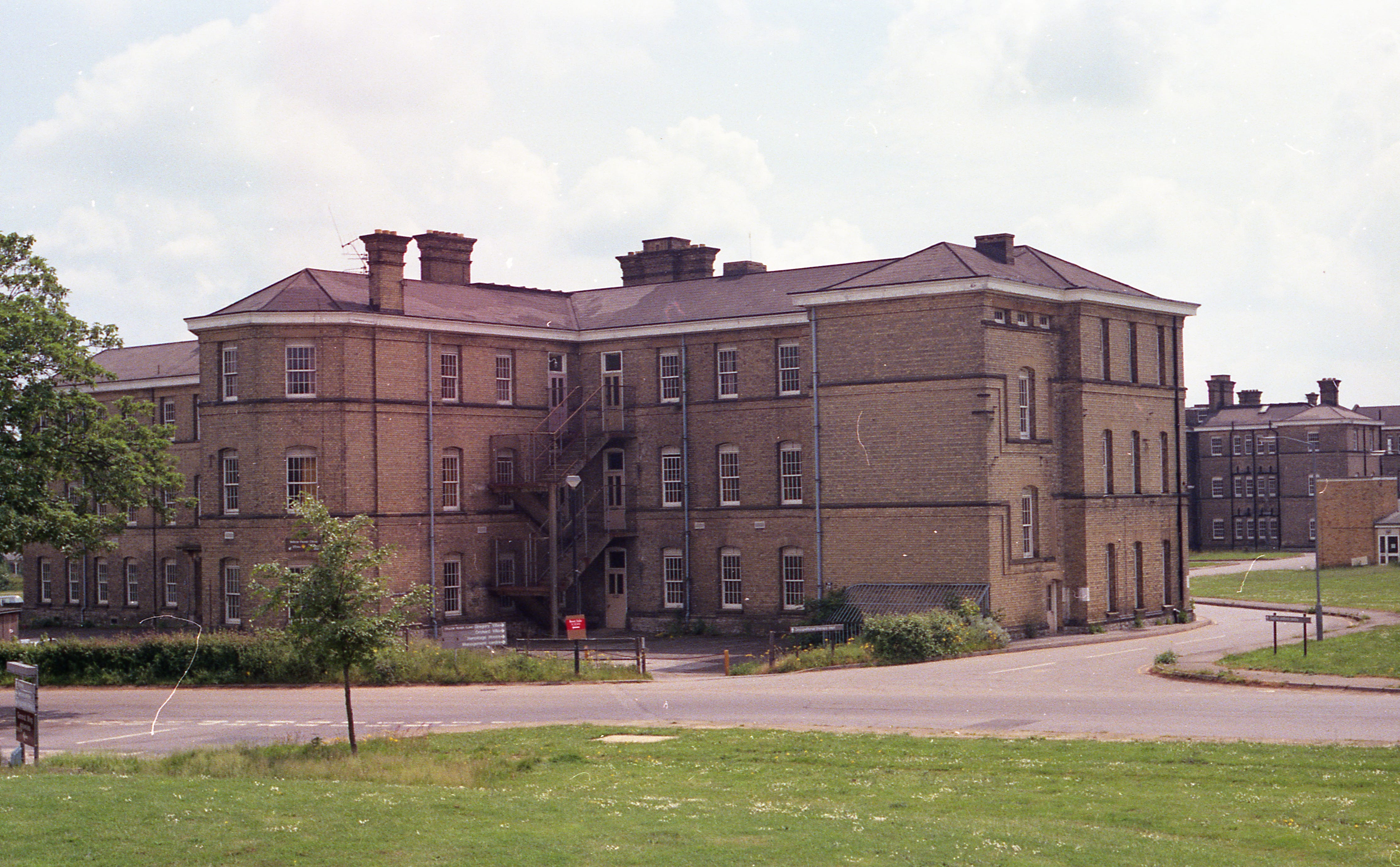
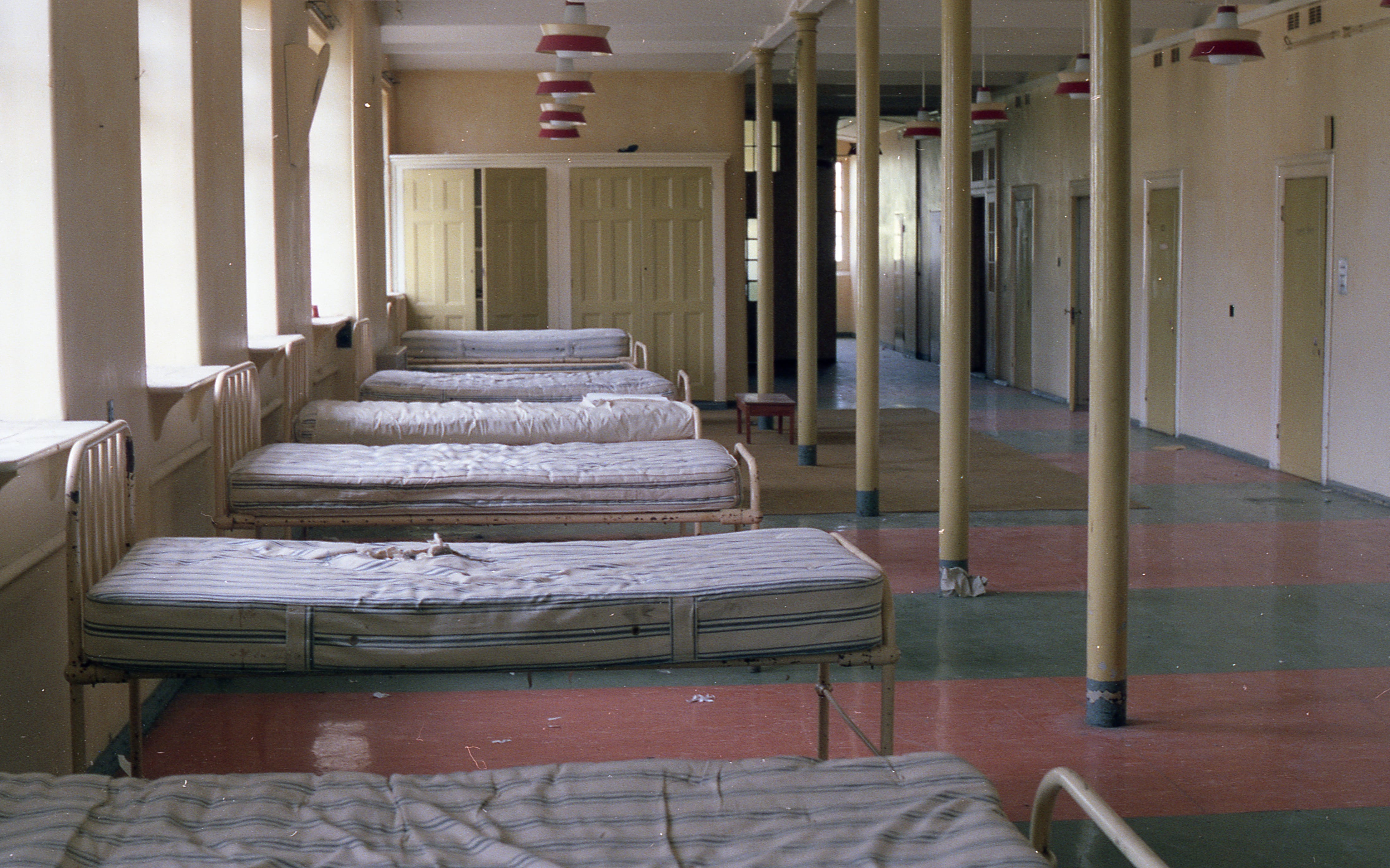
I dressed the set in the daytime on my own, having chosen a ward on the first floor, that had the most character and period detail. All the broken-down metal framed beds were stacked up in sections on the ground floor, where all the windows had been boarded up for security, so I had to carry the headboards, footboards, spring frames and mattresses up to the first floor, assemble each bed and line them up against the outer wall, under each sash window.
However, when I opened the door to the ground floor ward, I realised the light switches were located at the other end. I hadn’t brought a torch, so I had to walk down through the ward in complete darkness.
I got about half way when I suddenly felt the foreboding sense that someone or something was following right behind me. The hairs on the back of my neck stood up, making me shudder. My quickening pace turned into a blind, frantic run for the door at the other end of the ward. My hands fumbled for the light switch panel. I flipped every single switch I could feel, but of course these were all fluorescent lights, which meant they took a moment to warm up before coming on.
The delay, as I stared wide-eyed into the darkness, was unbearable. Eventually, one-by one, they started to flicker on and my eyes darted from one illuminated area to another, expecting to see what it was that was following me, but of course there was nothing. I don’t believe in the supernatural, but I don’t think I’ve ever scared myself so much in my life.
I managed to convince nine of my drinking buddies from the Minstrel pub in Maidstone, to play the various men in the hostel - including Mark Hedges who, to my surprise, fell into the role of hostel warden incredibly well (He later became a policeman). The easiest way to get them all to come to the location at the same time was to literally walk them there from the pub after closing. As a result, they were all pretty drunk and hard to control, but then in some ways that might have added to the authenticity in the end.
For the shaft scenes, I was stuck. I couldn’t find any kind of usable location anywhere in the Maidstone area, but then by complete chance, I went out for some drinks with a few friends at The Chimneys pub in Leybourne, where I discovered they had an old water well inside (it has since been removed). I returned to the pub a few days later (when I was sober) to ask the management if I could use it out-of-hours for filming. They agreed to let me have access for a couple of hours in the morning, when the cleaners were in, just before they opened.
The water well had a metal safety grill fixed to the top, to stop stupid people falling in. It was only held in place by a few brackets, screwed into the brickwork. I can’t remember if I explained to the staff that Ant was going to have to lay on top of the grill, or that we would remove it for a few ‘dangling’ shots (I was the stunt double for this). If the brackets gave way, Ant could potentially fall twenty foot or more. If I did tell them, such obvious danger clearly didn’t sink in, which is one of many reasons I miss the nineties so much - people were not so overly health and safety conscious back then and were a lot more open to teenager’s creative pursuits. To be fair, I did attach a rope to Anthony’s ankle (and later his waist) just in case.
Although I got the footage that I needed in the well, the sound was problematic. You could hear the cleaners and bar staff chatting and laughing in the background and music was playing from the pub speakers. On a few takes you could even hear the vacuum cleaner starting and stopping. My vague solution was the same - to re-record the dialogue on my Walkman Pro. My first priority though, was to get the last two remaining scenes shot.
Why I had to abandon DREAD
I had originally intended to make Dread in my year out between college courses, so that I had something new, more serious and more accomplished on my showreel for my upcoming interviews, but I only managed to shoot 60% of the script in that year.
Despite this, I cut a trailer from the footage, which got me a place on a Media Production course at Harrogate College of Arts and Technology. So, in that sense, the project served its purpose whether I finished it or not.
However, I’m not the kind of person who can just leave creative stuff unfinished, and so during my term breaks, I would come back to Maidstone to try and shoot a little bit more. However, it was increasingly difficult to find any free time with Ant and Paul together.
The shaft scene in the water well, ended up being the last scene I ever shot for Dread, because the next time I came home, Ant had cut his hair short and I thought, well that’s the end of that then. Of course, I couldn’t really expect them to keep the same hair style forever, just for my benefit, especially now that I was growing mine long. It was simply a sign that time was moving on.
I recently discovered another reason I was under pressure to finish the film. Among some notes I’d written on an old computer file at college, I found the following:
“I need to rewrite the script to allow Paul Hardy to finish the project as soon as possible. He is too tied up with work to spare the time needed to finish the film. I must come up with a way of omitting unimportant scenes involving Quaid, so I can still tell the full story!”
Frustrated but clearly not deterred, I sketched out an idea of how I could complete the two major missing scenes, without having to see the characters in detail.
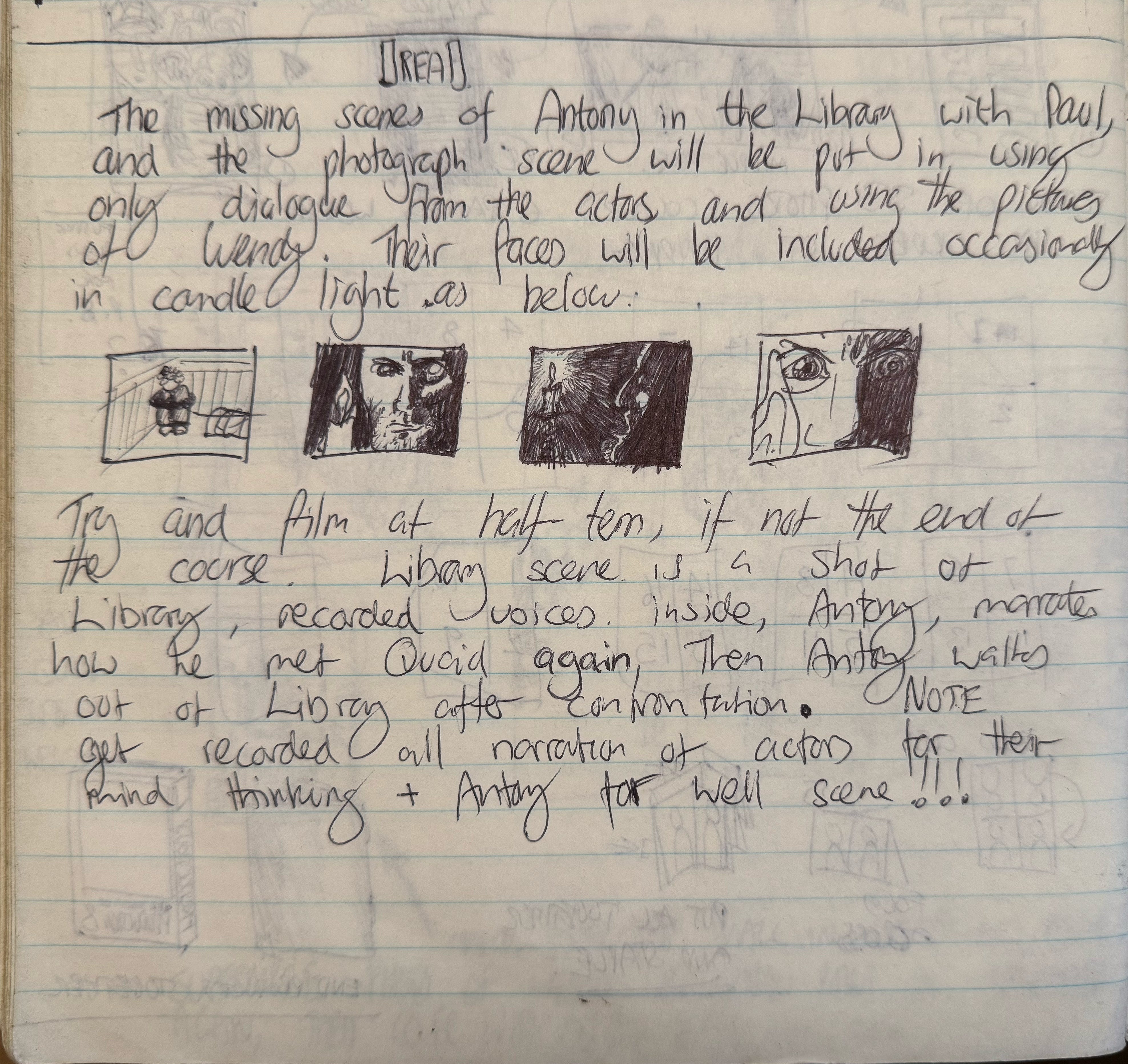
However, with a new, bigger and more ambitious 16mm film project on the horizon, these plans never came to fruition, meaning my footage remained untouched for many years to come.
Meeting Clive Barker
I went on to study a BA in Media Production at the University of Northumbria in Newcastle Upon Tyne, where I regularly went to see movies at a lovely little independent theatre called The Tyneside Cinema. It was there, in maybe 1995, that I saw advertised a special screening of Hellraiser with a Q&A afterwards with Clive Barker.
Anticipating this one-off opportunity, I bought a ticket and made a VHS copy of my Dread trailer, with an accompanying letter for Clive Barker. I wanted to know if anyone had the theatrical rights to Dread, explaining that I had made an amateur version of it when I was younger, but that one-day I’d like to make it for real.
At the end of the Q&A I hurried down to the front of the theatre to try and give it to him. I can’t actually remember if I handed it to him personally. I have a feeling he was already inundated with people wanting to ask him questions or get an autograph, so there might have been an assistant I gave it to. Either way I managed to pass it on (and get his autograph), not really expecting to hear anything back.
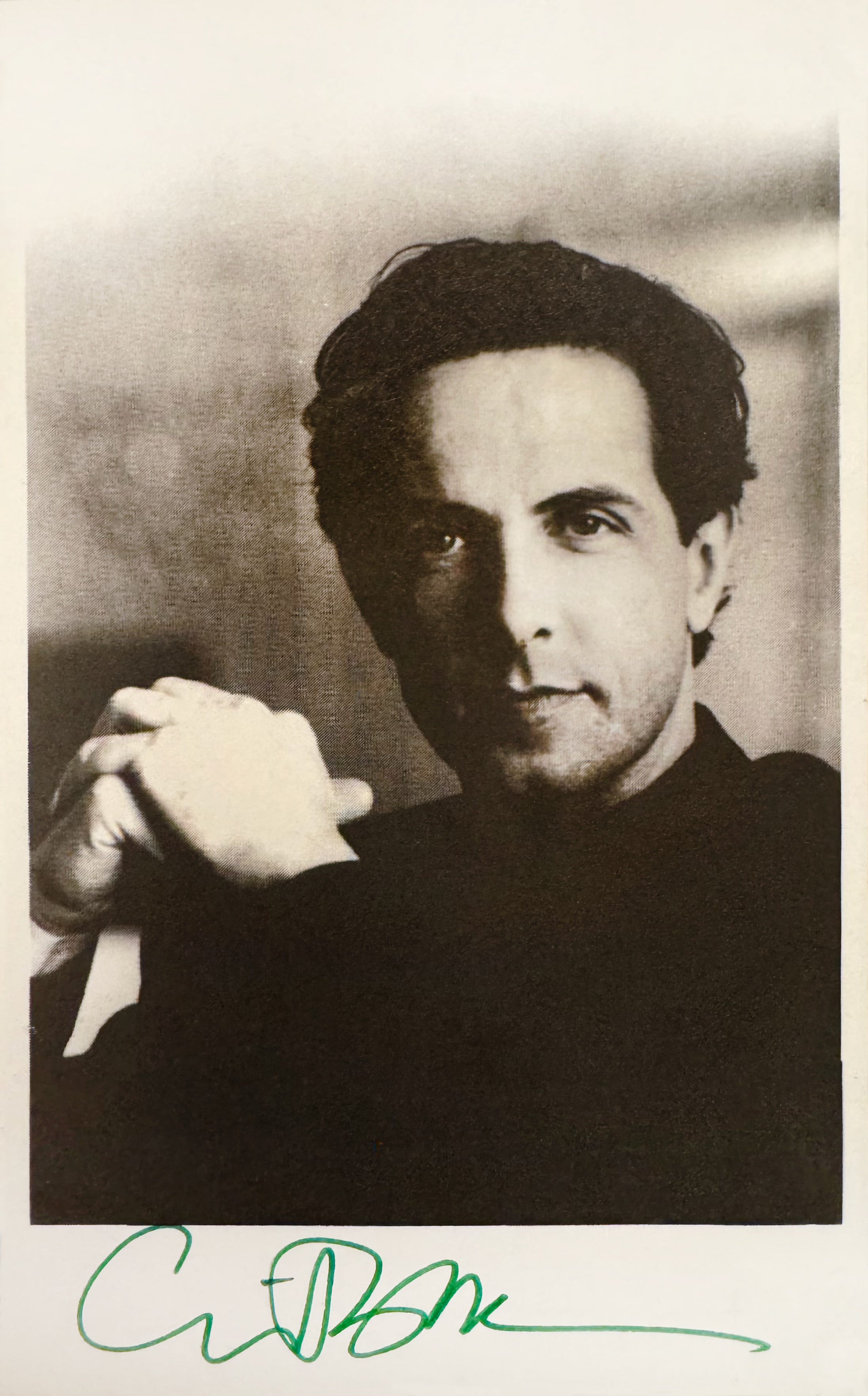
However, a few months later I was thrilled to get a reply from Seraphim Films, who acknowledging receipt of my letter, informed me that the rights to Dread were currently unavailable, but that I should contact them again when I had finished my studies. I was super excited at the time, relieved that I still had time, wondering if this would end up being how my directing career would kick-off.
Unfortunately, by the time I did finish my course, two years later, I was whisked away to London, having miraculously landed a job on Star Wars - The Phantom Menace.
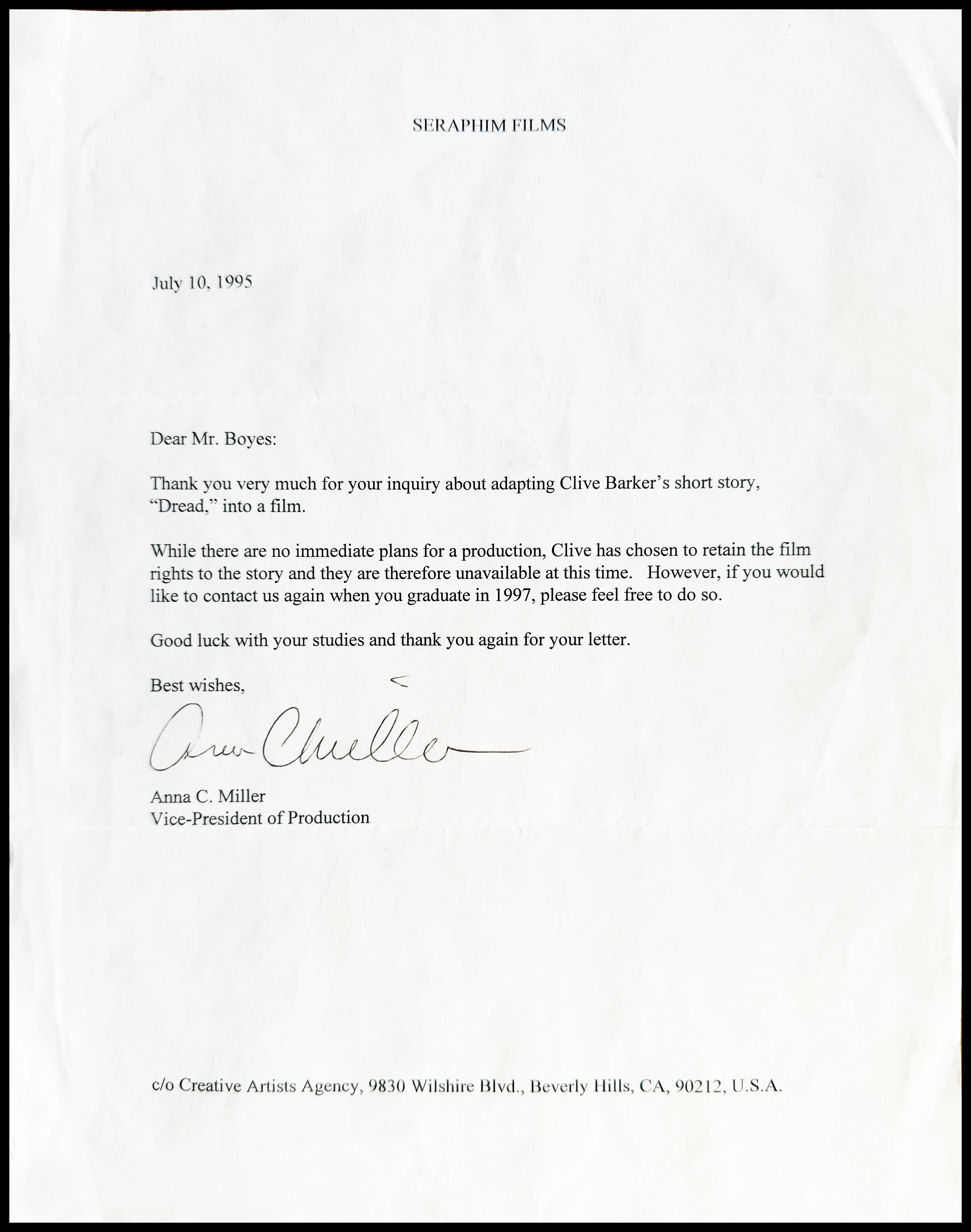
In truth, I wasn’t skilled enough back then to have been able to deliver a convincing pitch to Seraphim Films. It would take another seven years and an MA in fiction direction at the National Film & Television School, to have fully found my voice and be capable of offering a professional, clear and enticing vision.
Oliver Parker
A year after working on Star Wars, I happened to get a job as a production runner on a film called An Ideal Husband. It was Oliver Parker’s debut directing a feature film, having formerly been an actor. He openly admitted to the crew that he was still very green and I was impressed by his humbleness.
After principal photography had been completed, it took a few weeks to wrap everything up. We were based at Leavesden Studios and on one of these days, I was asked to drive Ollie into central London. This was a perfect opportunity for me to ask him a thousand questions about his directing experience. After the initial polite silence, it didn’t take long before we were chatting away like old friends and somehow came onto the subject of Clive Barker.
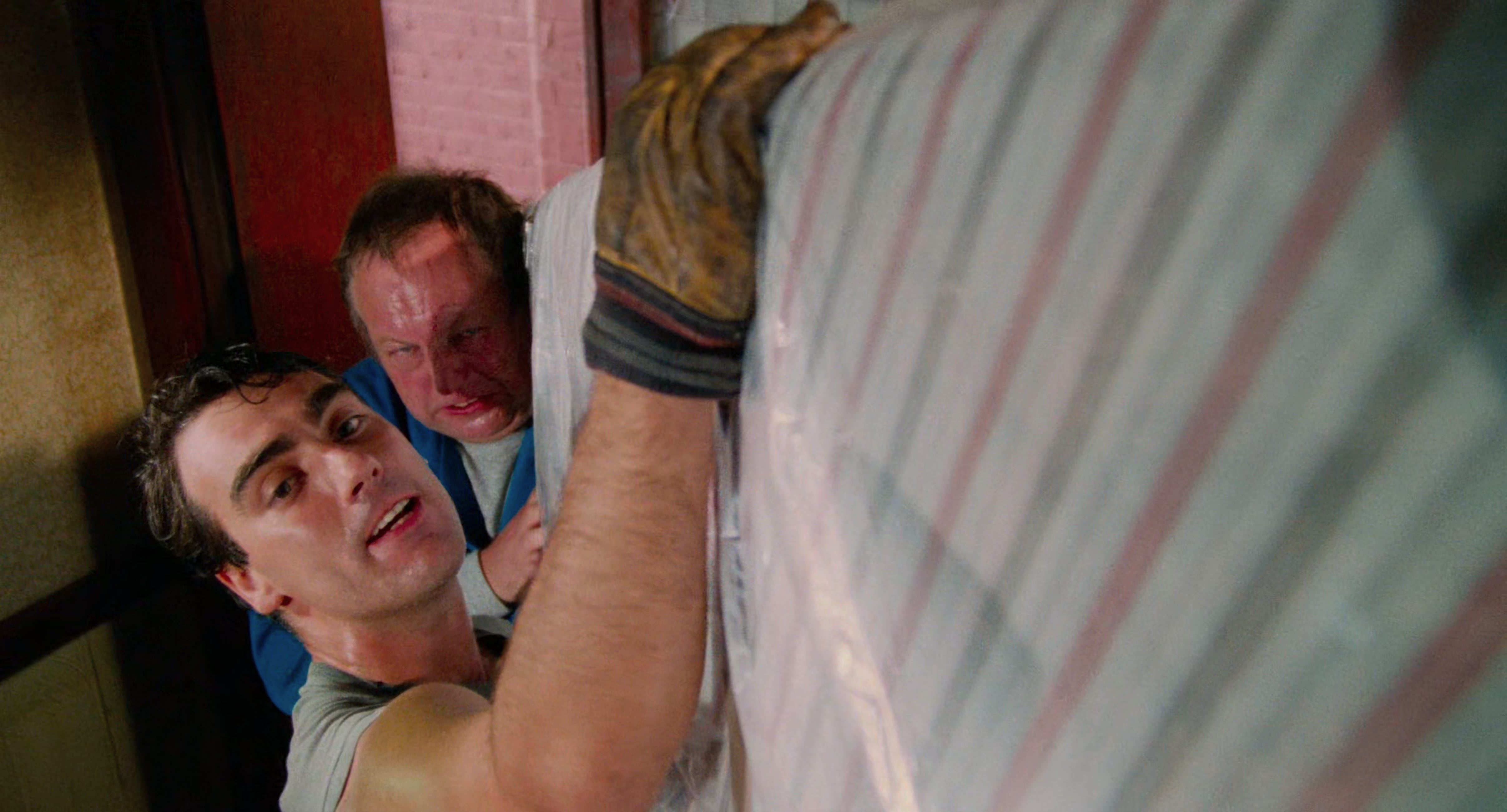
Incredibly, Ollie revealed he had been flatmates in London with Clive Baker in the eighties, when he was a struggling actor and that Clive had given him a small part in Hellraiser as a removal man. In return Ollie ended up giving Doug Bradley (Pinhead from Hellraiser) a small cameo in An Ideal Husband.
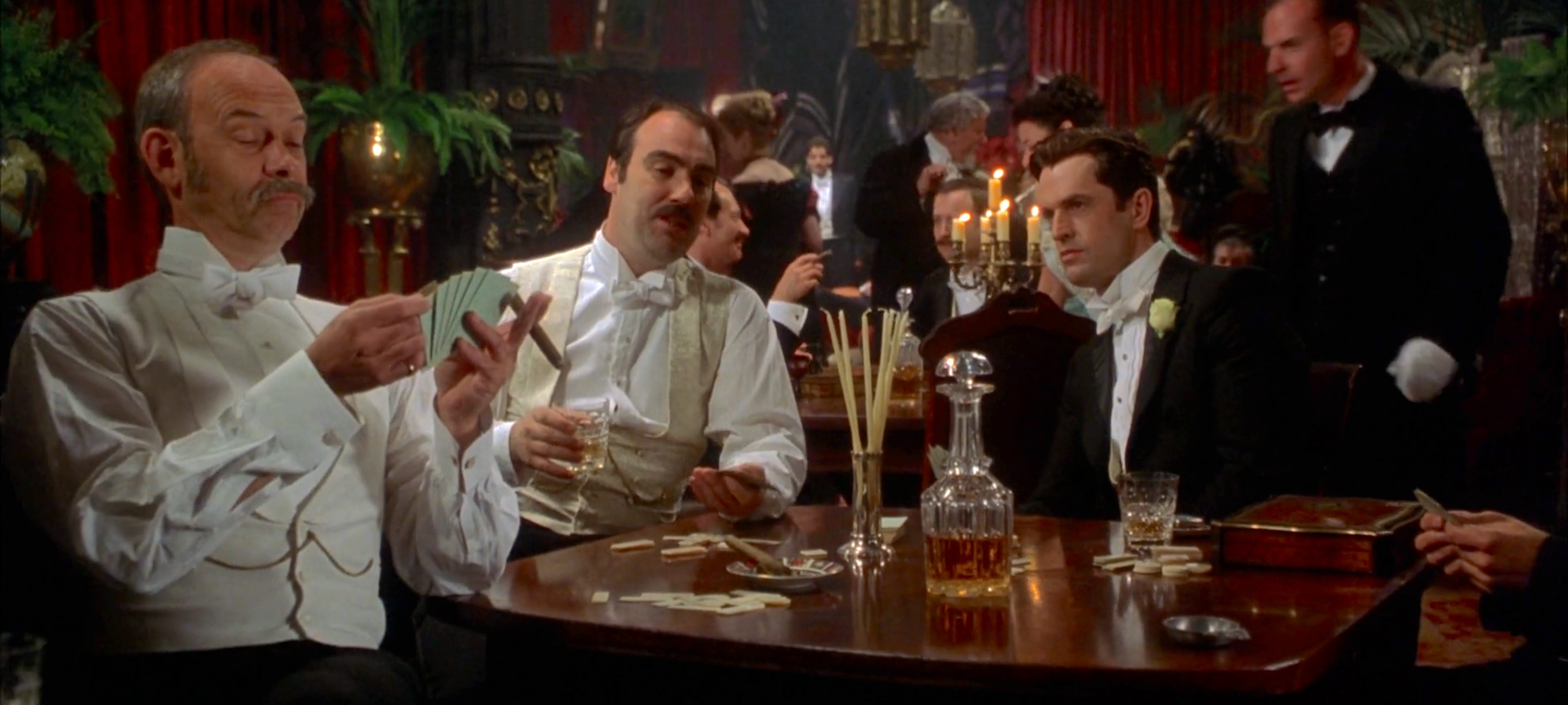
Excited, I told Ollie about my early video adaptation of his short story Dread. He then revealed that Clive was in negotiations with the BBC to adapt Books Of Blood into a TV series. I was gobsmacked. I wanted to be the one chosen to direct Dread for the BBC and was kicking myself for not getting back in contact with Seraphim Films.
He also went on to tell me that Clive had recently asked him to direct a theatre production of Hellraiser, which I immediately thought had huge potential - as it could be highly innovative, immersive and visually breathtaking.
Fortunately (for me at least) nothing ever came of the BBC negotiations with Books Of Blood, but eventually Clive Barker would find another way to get more of his short stories adapted for the screen.
On a side note, I coincidentally met Doug Bradley socially, during the 2005 Fantasporto Film Festival in Portugal, where my NFTS graduation film, The Happiness Thief was playing in competition.
When we shook hands, he introduced himself to me as ‘Doug Bradley’ and I said “Oh yes, you were in…” He nodded with a tired look, expecting me to say Hellraiser, but instead I said “…An Ideal Husband.” He looked at me shocked and said “Yes, yes I was!” As a result, we ended up hanging out together for the rest of the evening.
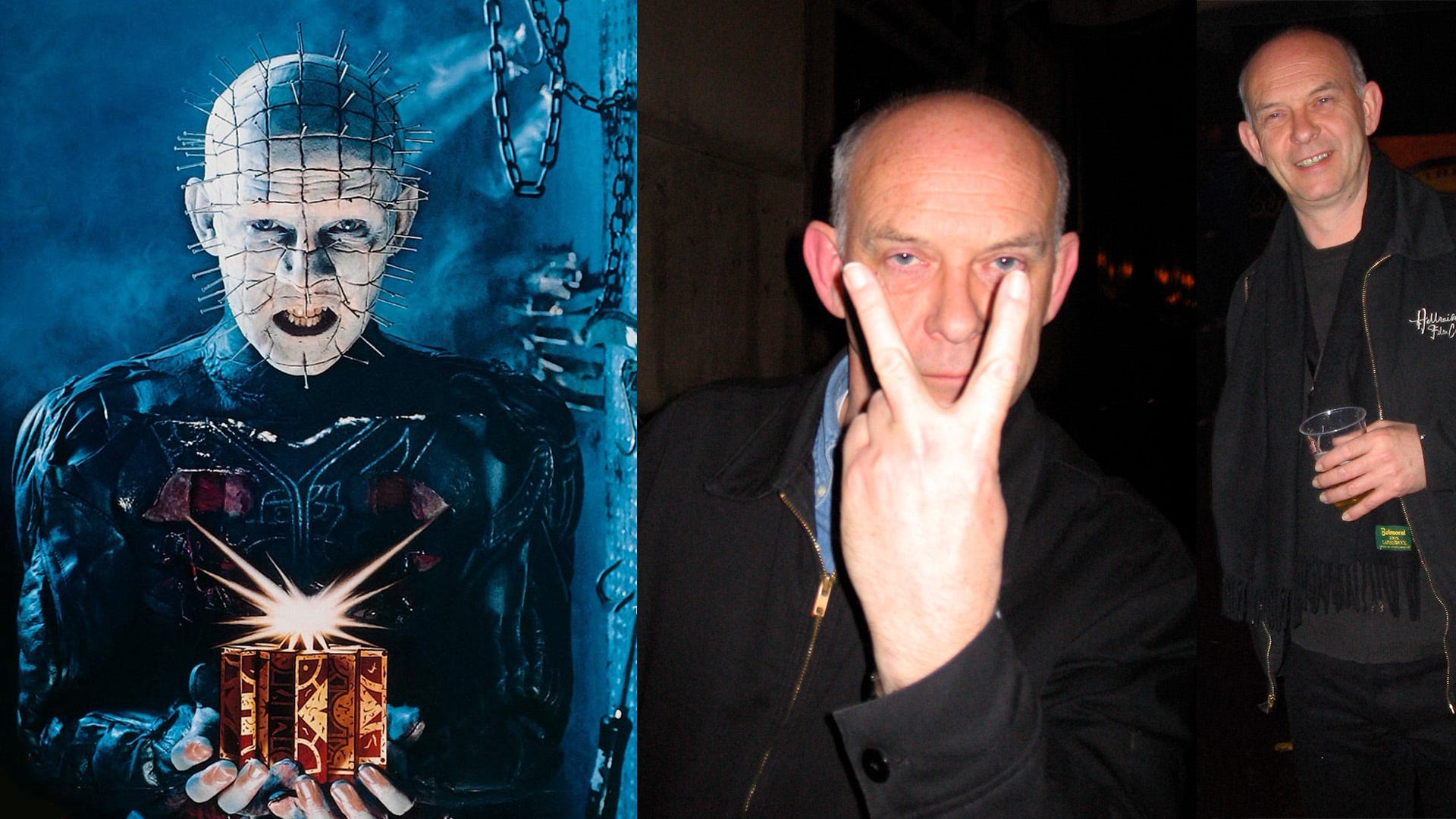
In researching this piece, I came across a wonderful episode of the South Bank Show from 1994, all about Clive Barker (via YouTube and split into five parts) that reveals Doug Bradley is in fact an old school friend of Clive Barker and that after University, he, along with Ollie Parker and another actor Mary Roscoe, formed a fringe theatre group with Clive called The Dog Company, which explains their long collaboration and close friendship.
The 2009 feature film adaptation
When I heard they were finally making Dread as a feature film, I was both gutted and excited at the same time. Especially as I knew the editor, Celia Haining. She was a close friend of a friend I’d met on An Ideal Husband and so it felt like more than just a coincidence. It felt like fate was having another dig at me, as if to remind me how stupid I was for not following up Seraphim Films letter.
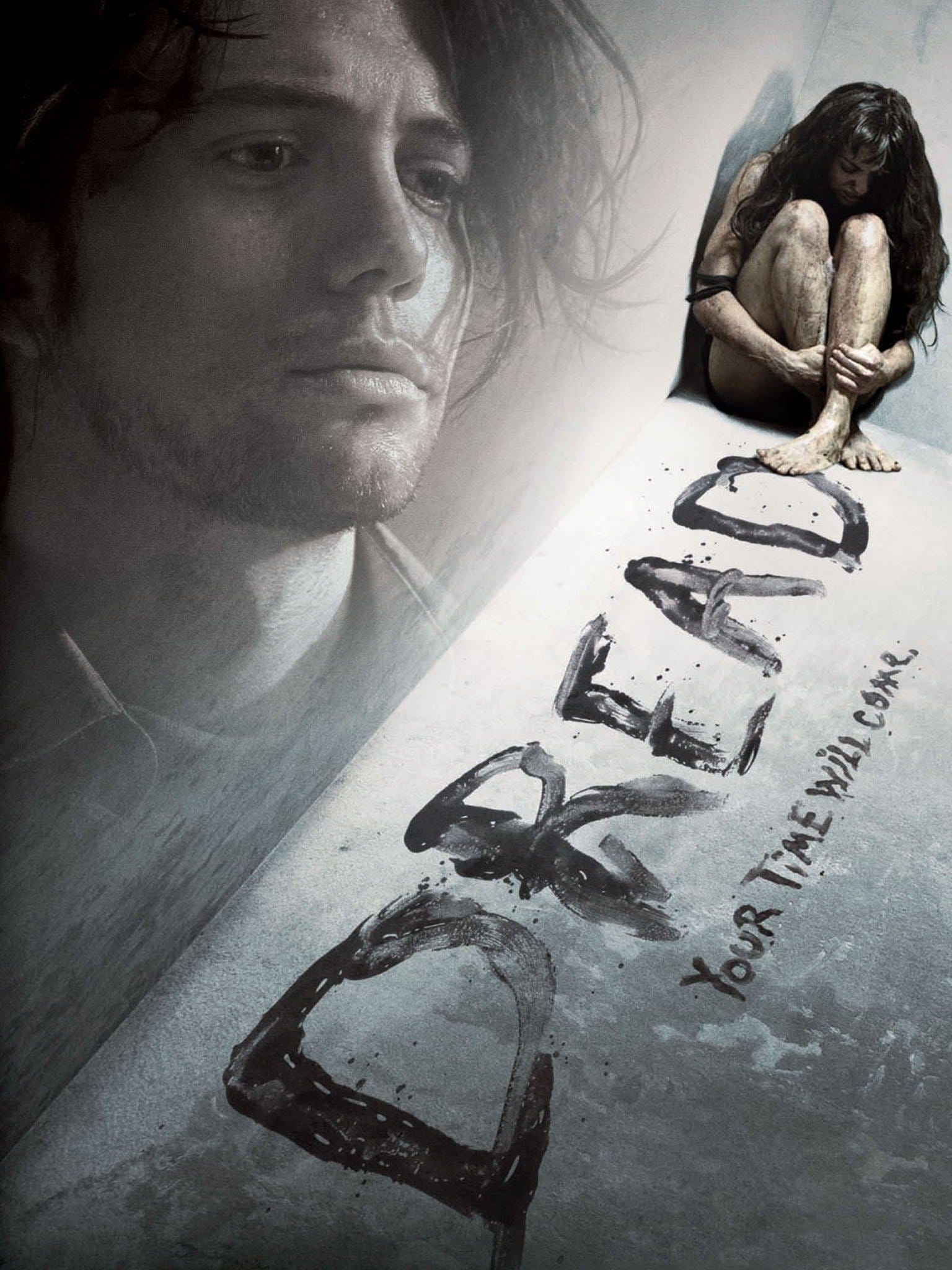
Principal photography commenced on Dread in London on October 15, 2008. Ironically, at that same time, I had just written a taut psychological thriller called Blackout, set on the barren landscape of the Isle of Sheppey in Kent, as part of a very successful nine-month feature film development scheme with Ipso facto Films.
I was just a month away from pitching this micro-budget feature, to win a £250,000 production prize, having already attached Martin Compston and Jessica Hynes as the two main leads. In addition, I’d shot a great finance trailer to go with it, made for less than a couple of hundred quid.
My future prospects appeared very promising at that time, but then misfortune will often strike at such pivotal moments, just when you least expect it. If I’d have known then how my situation was going to turn out, I’d have jumped at the chance of joining Seraphim’s apprenticeship scheme and making DREAD with them instead.
First Impressions
I eventually managed to watch Anthony DiBlasi’s film version on DVD in 2010, but when the credits rolled, I felt like banging my head against a brick wall in frustration.
For me it was barely more interesting than your typical ‘straight to DVD’ horror film. It had none of the depth and potential of the original short story. Rather than delving deeper into what was already there or hinted at in the short story, the director Anthony DiBlasi attempted instead to expand the story, updating DREAD for a modern teenage horror audience and setting it in present day USA (despite filming in the U.K.). In doing so, he diluted its potency, robbing the original material of its rich identity, depth and cinematic potential.
As I saw it, a large part of the visceral success of the short story, was the time and place in which it was written. As more time goes by, the stronger I believe that 1980’s England is imperative in tapping into what influenced Clive Barker to write the story in the first place and why it became so popular. I felt that DiBlasi’s film failed to appreciate and utilise this fact.
Clive Barker was reported to have been very proud of the final film and so I cringe having to criticise it. However I believe I have a better vision, that is respectful to the source material, while enriching the narrative for the screen. With a bit more careful thought, creativity and imagination you could translate the psychological aspects of the short story far more effectively.
I appreciate they had a very modest budget which would have limited what they could realistically achieve (I still haven’t been able to find out the actual cost), but low-budget doesn’t have to mean low production value. In addition, I suspect some of the misguided decisions were the result of certain pressures and expectations that came from the particular finance model they had to work with, so I don’t want to put all the blame on DiBlasi.
“Dread is a picture I’m very proud of. Somebody who came in as an intern [at Seraphim], Anthony DiBlasi, ended up adapting it and directing it. I was very proud of the fact our apprenticeship system worked very well.”
Clive Barker - 2009 Den of Geek interview
Overall, the film lacked a sense of place. It felt claustrophobic, with too many ‘television style’ talking head shots and a lack of wide cinematic compositions, especially in terms of establishing shots. The harsh high-contrast colour grade and 2.35:1 ratio seemed to be an attempt to compensate for a lack of consideration in cinematography, cinematic locations and resourceful production design. The film focussed on typical ‘straight to DVD’ horror tropes aimed at a teenage market - explicit sex scenes, with conventionally attractive actors and excessive, unrealistic violence and gore, layered with exaggerated sound effects. The original short story is so much more restrained and well crafted.
Problematic Backstories
DiBlasi offers backstories to help explain each character’s personal dread, which I would have exploited too in a feature-length film, but I found his interpretations to be too obvious and cliched - likely a sign of his inexperience as a writer (rather than as a director), this being his debut.
The alteration to Quaid’s re-occurring nightmare was a ‘literal’ substitute - becoming a real childhood trauma instead of a nightmare, revealed through flashbacks, that showed a madman with an axe (not a clown), breaking into Quaid’s family home and slaughtering his parents in front of him. This event feels very far-fetched to me and rather unsophisticated when you consider what the original story hinted at.
The only aspect of this flashback I did find unique and original, was the fixed camera on the axe head as it’s dragged up the stairs.
For me, Quaid’s reoccurring nightmare of a clown wielding an axe, is an abstract metaphor for whatever Quaid’s real trauma stems from, which should not be fully revealed until the very end of the film, when Steve is slaughtering him.
By revealing the root of Quaid’s dread at the beginning of the film, you’re allowing the audience to understand his behaviour and even sympathise with him. However, if you save it for the end, Quaid’s actions will appear far more unpredictable, scary and disturbing, before revealing a satisfying “aha” moment of understanding at the end, that neatly ties up the whole point of the story.
You could say that a clown’s make-up is a form of mask, which suggests deception. Sigmund Freud saw scary clowns in dreams as symbols of repressed emotions. So, I would be more inclined to make Quaid’s trauma a repressed memory of his mother’s betrayal. Something that might also connect the seemingly tragic death of his parents and his animosity/interest towards Cheryl. I think there’s far more potential to be thought out here.
Then there is Cheryl Fromm’s fear of meat. In the short story it is implied that her reason for her vegetarianism is a typically naive revulsion to modern meat farming, but in the film, Cheryl’s fear of meat stems from her dad smelling of meat when he molested her as a child, after returning late from work at a meat-packing plant. The problem with this, is that the backstory is far too extraordinary and dramatic, taking away the impact of her main plot. It also reminds me of a crude imitation of Starling’s childhood trauma in Silence of the Lambs.
For me, Wendy’s resistance to the meat in Quaid’s experiment should be a mixture of sheer stubbornness rooted in her personality and a more realistic childhood traumatic experience, like witnessing a fox ripping apart a beloved pet rabbit.
This was something that actually happened to my sister, except we told her the rabbit had been stolen. Me and my Dad managed to pick up all the chunks of fur scattered across the garden before she realised. We even found its tail and hid it behind a stack of old bricks. It was only when my sister was well into her thirties that I dared to tell her the truth. I can easily imagine the trauma she might have suffered if she had gone to feed her rabbit that morning, only to scare the fox away to reveal the bloody, shredded remains of her beloved rabbit - That must surely traumatise a young child.
Steven’s ‘deafness and tinnitus in the dark’ was the most original dread in the short story (probably because it was based on Clive Barker’s real childhood experience) and yet it is the hardest to translate to a predominantly visual medium like film - which may be why in part, DiBlasi chose to give this dread to a less important secondary character, Joshua. The very fact that Clive took this from his childhood experience, tells me how potentially significant it could be. I’d want to learn more about this childhood experience, so that I could articulate such dread to its full psychological effect on screen.
Steven’s original dread is replaced in the film with a fear of driving, caused by his drunken brother accidentally killing himself in a car crash, but the way this idea plays out in the film is rushed and clumsy. We never get a true psychological understanding behind such dread, making it feel ineffective and unconvincing.
The film also added a fourth victim called Abby who has a large birth mark that covers her face and much of her body. Although I thought it a perfectly legitimate alternative dread to explore (the apprehension of public humiliation that might come from having such a large birthmark exposed), scrubbing her birthmark with wire wool, in a bath full of bleach, requires some serious psychological demise, that without proper exploration, makes such an outcome highly unbelievable. I also feel that her character’s addition to the narrative unnecessarily overcomplicates the plot and weakens the spine of the story, destroying the implicit psychological tensions between Quaid, Cheryl and Steven.
The film ends not with Quaid being axed to death by Steven, but with Joshua killing Steven with a single blow of the axe to his chest. Quaid then shoots Joshua dead, so he can stare into Steven’s eyes, as the life drains away from him. He then offers Steven’s corpse as potential ‘meat’ to keep Cheryl Fromm alive, who he still has locked up in a secret room. In the end, Quaid gets away with it all.
On the surface, this is perhaps a more shocking ending, but it is also far less sophisticated and unsatisfying. If you think about the purpose of each key character and how they support the themes of the story, this ending makes absolutely no rational sense. More importantly it destroys the most interesting element of the original - namely that Quaid gets his comeuppance in a beautifully ironic manner.
“May be my dreams are so preposterous they can only be true.”
Quaid
There is a reason why Steven’s dread is very specific in the short story. It creates a particular psychological demise (into an innocent child-like state), that perfectly explains how someone who is not psychopathic, could stomach butchering another human being, without any hesitation or repulsion. Steven, through child’s naive eyes, is only chopping away at Quaid to see the wonderful patterns of bright red ‘paint’ flying up into the air. He is oblivious to the real bloody violence he is committing - It’s perfect.
Revisiting my 90’s Dread footage
As a form of therapy to ease my disappointment with the 2009 feature film version of Dread, I decided out of sheer curiosity, to revisit the Video 8 footage I had shot in the early 90’s and to edit together all the scenes I had managed to shoot of Dread. In doing so, I was pleasantly surprised to find that some scenes worked very well, considering how young and inexperienced I had been. It reassured me that the original short story was indeed far more interesting than the 2009 feature film adaptation, even in the hands of a teenage amateur. I then subsequently forgot all about Dread for the next fourteen years.
Finally Finishing Dread in 2025
Since 2013, I have been digitally remastering and archiving all my film work to date. Having completed the more accomplished films of my career first, I then started to look at the older material I had shot on domestic video formats and by late 2024, I finally got around to addressing Dread.
Initially I was just going to remaster and upscale the rough cut that I had put together back in 2010, but my curiosity got the better of me. Having so many useful post-production tools available to me now, I realised I could correct and enhance much of the footage I shot, giving me credible hope for the first time, that I could finally finish this film.
I started by reading through my original script and converting it into the correct screenplay format. I then cross-referenced it with the original short story, and the graphic novel by Fred Burke (and wonderfully illustrated by Dan Brereton). I made sure every scene in the short story had been added to the screenplay and that any abstract passages had been translated into new scenes, to make an ultimate screenplay bible. In doing so I was surprised to discover my nineteen-year-old self, had already adapted some of Clive’s internal narration from the book, seamlessly into an extended pub scene featuring Quaid and Steven. I’d just assumed their dialogue was copied word-for-word from original dialogue in the book.
I then went through the reassembled rough cut and managed to manipulate some unused footage to create a new, well needed opening with Steven Grace narrating an introduction to Quaid and his concept of dread. I slowly pieced together a coherent narrative as close to the original material as possible, recording temporary voice-over narration to bridge missing scenes or clarify plot points, and recorded temporary dialogue for the two major scenes I was missing.
I cleaned up all the original dialogue using AI, adding new atmos and sound effects to replace the noisy generator in Quaid’s house and the cleaners chatter at the pub, heard in the background of the shaft scenes. I trimmed the film down further, and through some very satisfying experimentation, created an effective dream sequence for Steven, where we reveal his confession to Quaid about the roots of his own dread and show his increasing fear of Quaid as a result.
When I originally adapted the story into a screenplay, my dad had introduced me to a piece of music by Stravinsky - The Rite of Spring. It was dark and menacing, just like Quaid and so to help stimulate my imagination, I played it as I wrote.
I recently found a copyright free version of it, performed by Jay Bacal and rendered using virtual instrument software by Vienna Symphonic Library. This meant I could layer the film with this license free music without having any copyright issues - I thought this was a fitting ‘no-budget’ way to score the film, in keeping with my limited 1990’s resources.
There are a handful of scenes I missed out from the book, that would add to world-building, character and plot, but are not essential. If I had the chance to make this film properly today, I would definitely have included them and in some cases expanded on them.
The one I miss the most, is a scene in Quaid’s kitchen, after Steve falls from the shaft (before he is discovered by the policeman). In this scene Steven, in a regressive child-like state, gets agitated, wanting his Mama. In a tantrum, he throws a load of Quaid’s files up in the air, many of which turn out to be graphic photos of people killed from axe wounds. The way Steven interprets what he sees, reveals his child-like mental state, helping to explain his mindless slaughter of Quaid at the end, while also offering the reader more insight into Quaid’s obsession with his own fear.
The only thing I had left to work out, was deciding what kind of visuals I should use to complement any newly recorded dialogue for these missing scenes. Would it simply be a case of using AI generated images to fill the void like a storyboard or graphic novel, or were there more advanced and creative ways to get the story across?
I had a couple of filmmaking friends, Martin Gent and Ryan Phillips, who are both early explorers in AI filmmaking. Their regular LinkedIn posts gave me enough insight to be able to experiment with various AI tools and platforms to see what was achievable.
Cast returns
I reached out to the original actors Ant and Paul to see if they would be willing to record all the missing dialogue that I had temporarily voiced. Fortunately, they still live close by and were both surprisingly enthusiastic about it which was great. The only downside was that they weren’t available on the same day, but it was still lovely to catch up with them both separately. We agreed we’d all get together when it was finished for a premiere screening and a group photo - which we did!
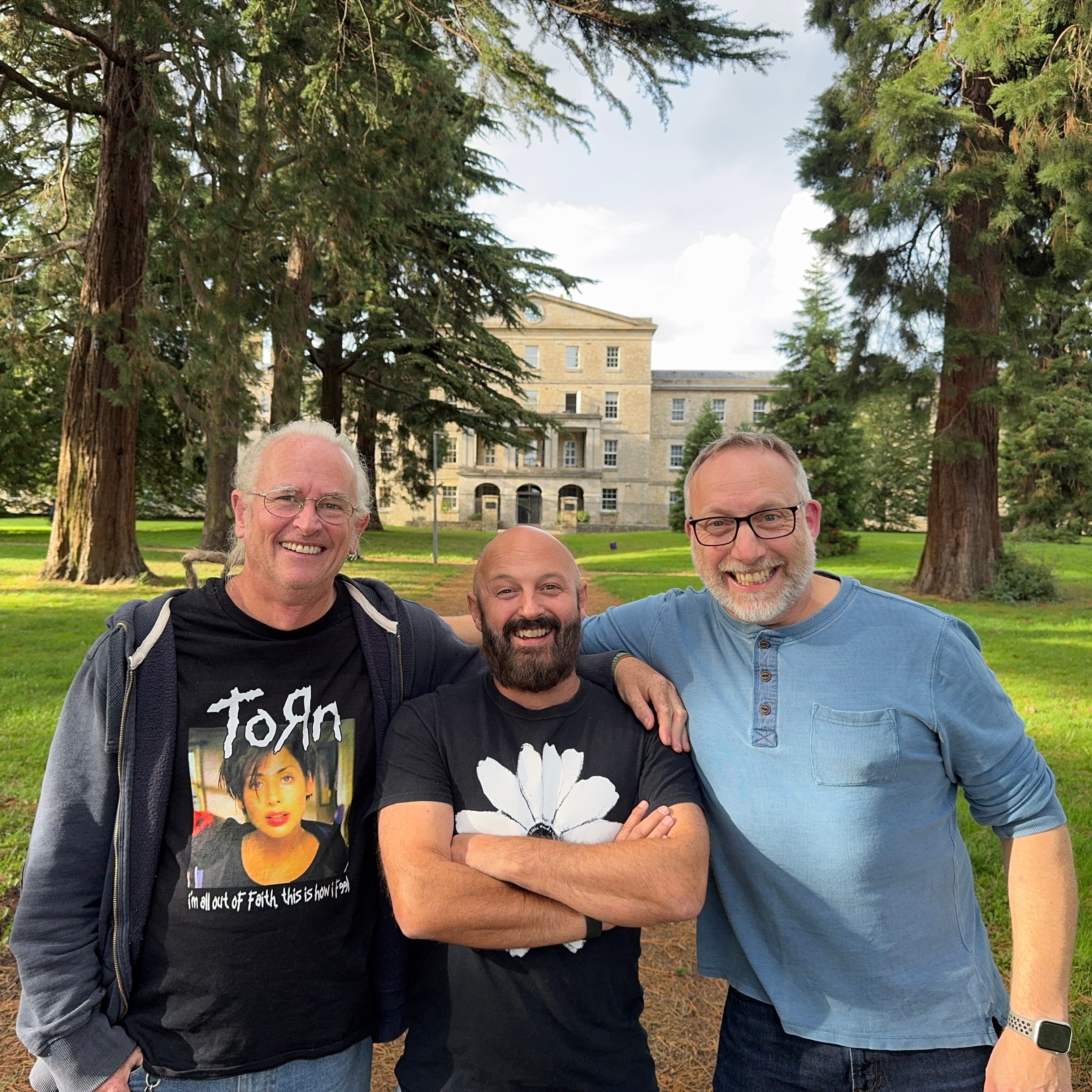
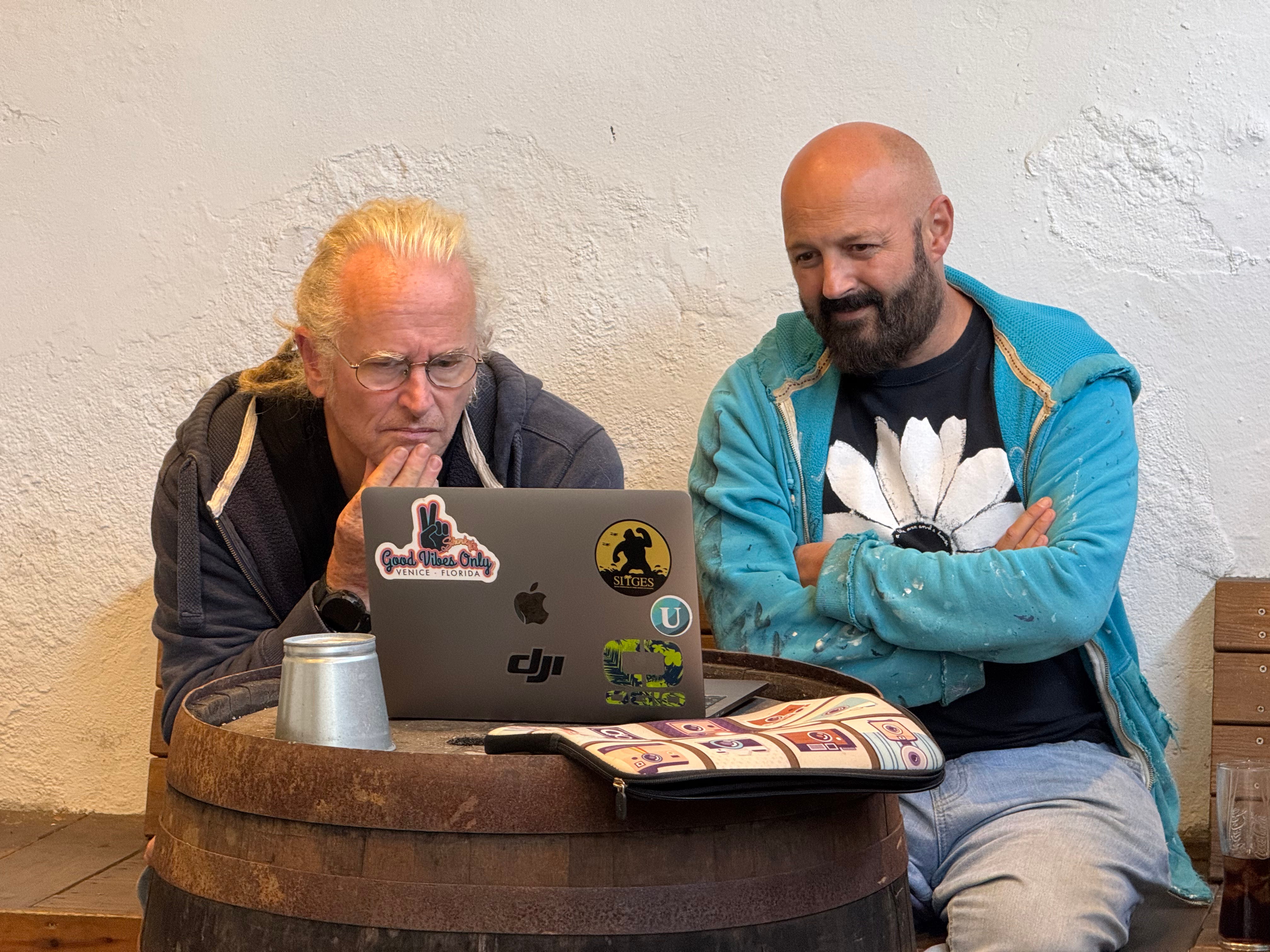
Paul and Ant’s voices, thirty-three years later, were both much deeper and huskier, which was not unexpected. I was hoping to fix this with a new AI tool in my editing software that can clone a voice perfectly onto another voice. Unfortunately, the original source that you want to clone from, has to be a clean, clear, high-quality recording, which Ant and Paul’s voices on all the Video 8 footage is not, so it didn’t work. However, laying them into the cut as they are, you can still recognise they are the same people and so I don’t really think an audience will notice.
AI and how it has allowed me to finish DREAD
It turns out that my solution to create these two missing scenes from scratch was not too dissimilar from the ideas I noted down back in 1992, except in 2025 I now have the advantage of artificial intelligence. In fact, filmmaking technology in general has progressed to such an unimaginable way in the last thirty years, that we can pretty much do anything and at very little cost.
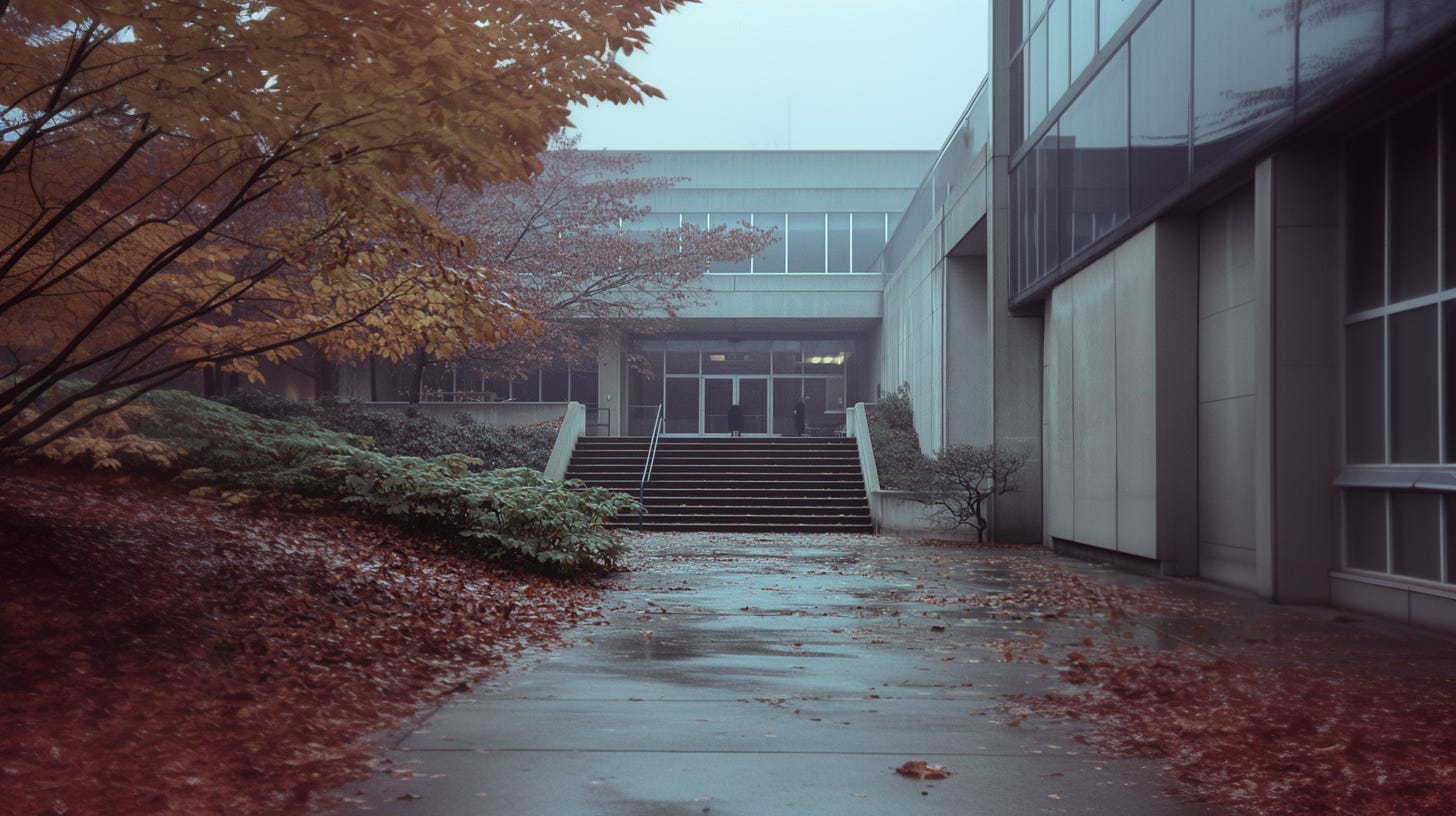
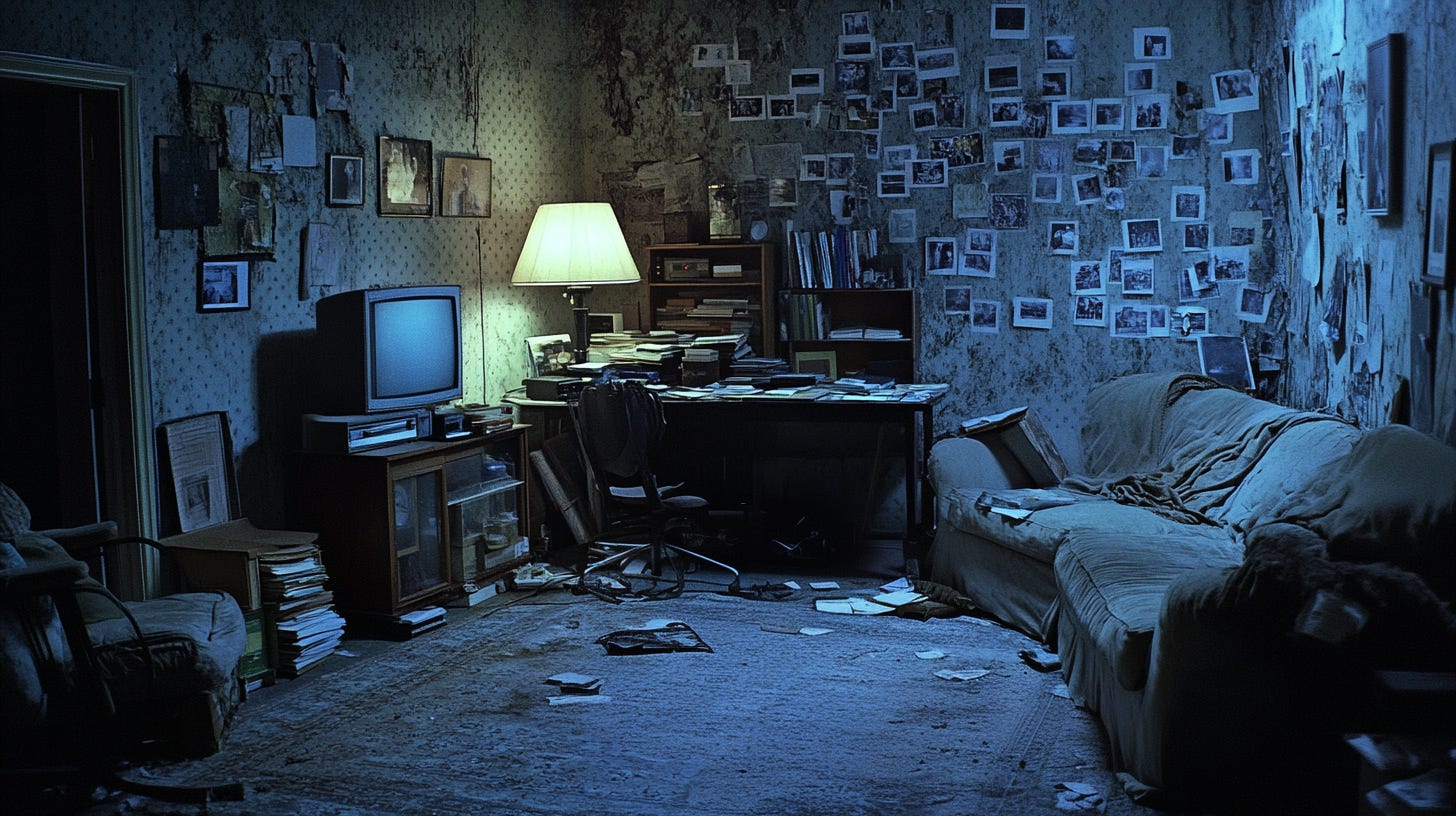
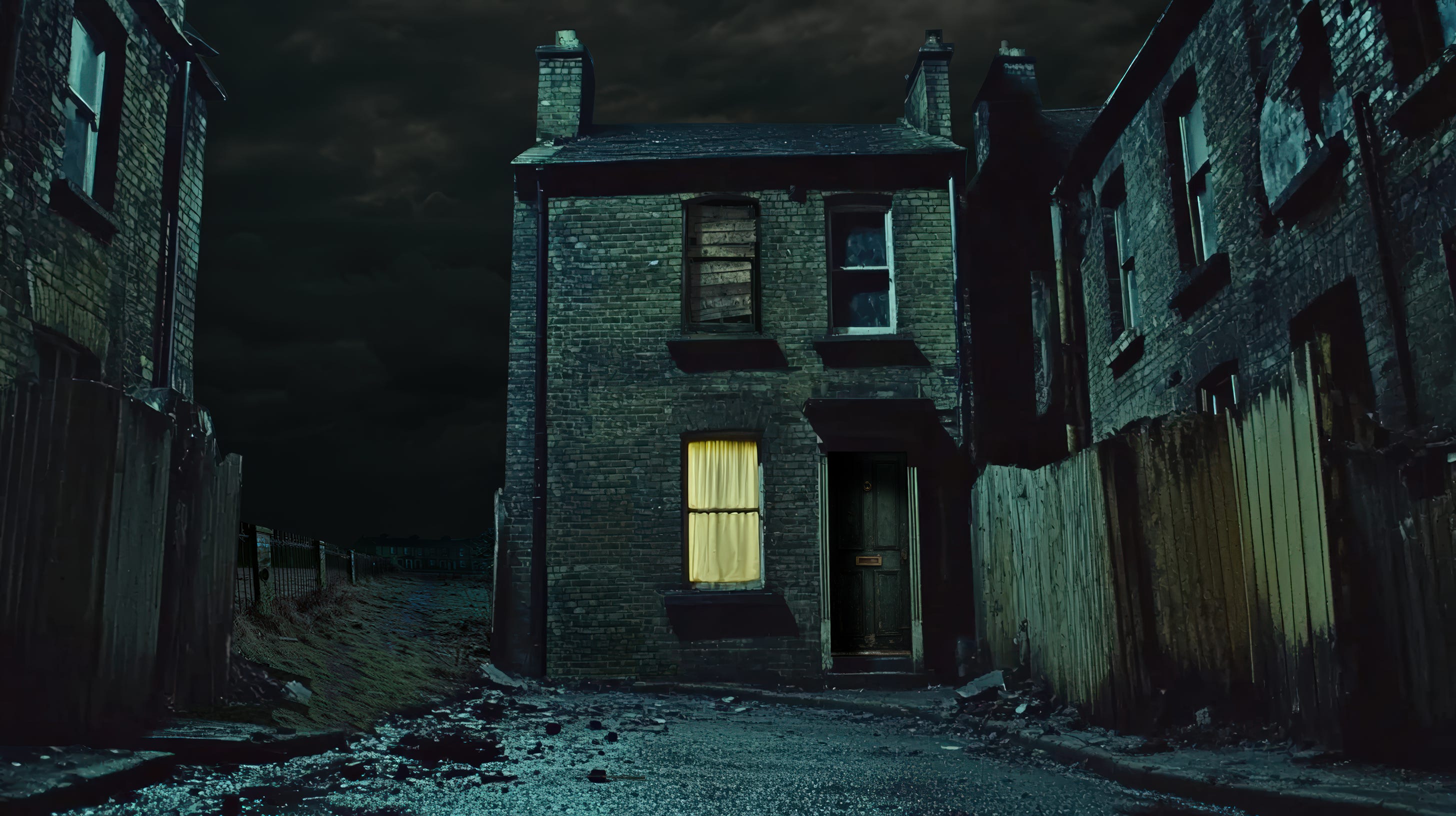
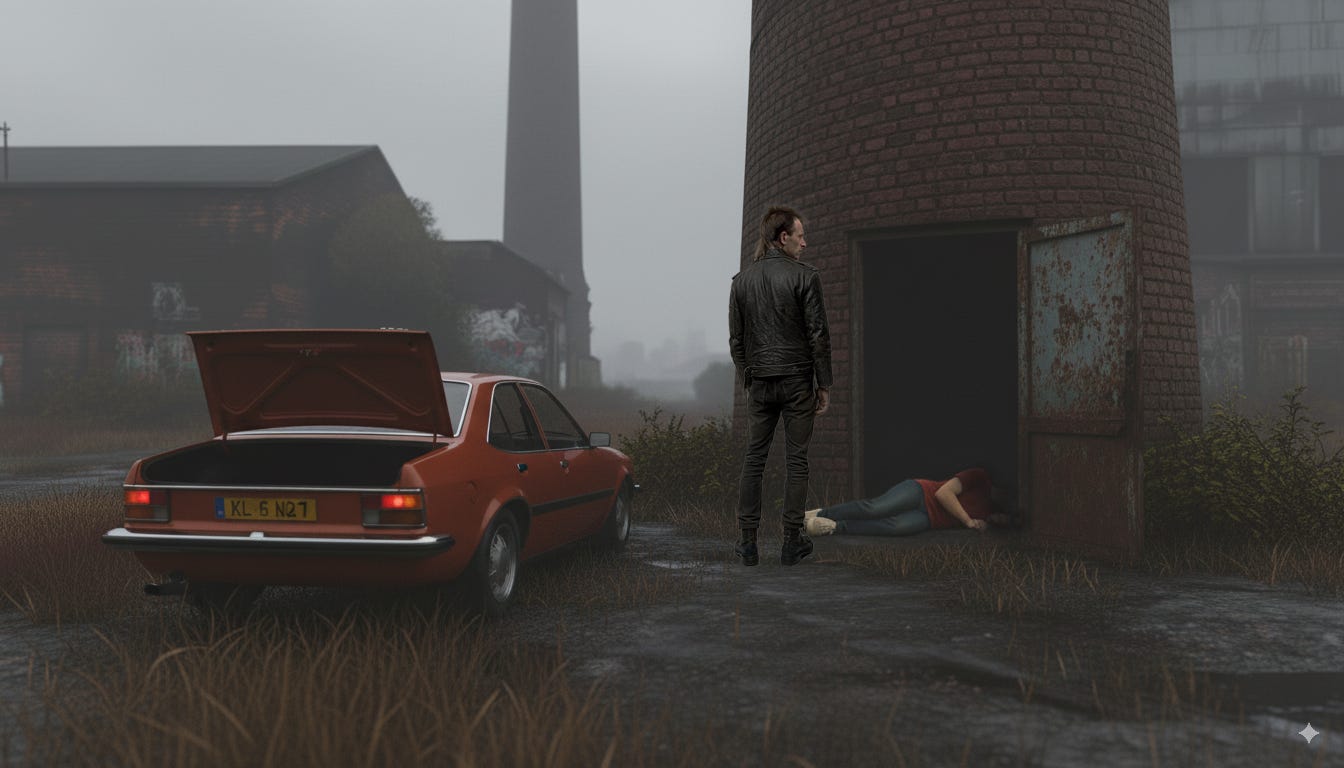
My first task was to generate believable establishing shots for the missing scenes, that fit the period and set the right tone. I used Midjourney as I had already had some experience of using it to generate images for my Substack pieces and to generate reference images for my film development slate.
I then used photoshop to combine elements or add and remove specific details or irregular errors caused by confused algorithms. Even though they will end up low-res, desaturated and cropped to 4:3, I generated them as colour hi-res 16:9 ratio images because that is the default setting for AI image generation and I didn’t want to confuse it unnecessarily.
I then needed to create detailed, high resolution full-length digital avatars of Quaid and Steven Grace, so that I could offer the AI models as much detailed information as possible on the characters. Unfortunately, all I had was the raw low-resolution Video 8 footage in which to grab close-up video frames of their faces and clothing.
I tried several different upscale AI models that didn’t really work. In the end I found ChatGPT generated the most accurate and photorealistic renditions of clothing, just from a single reference video frame and a bit of experimenting with the prompt. Although the generated faces looked nothing like the actors, the clothes were very detailed and resembled the kind of clothing the actors had worn in the 1990’s footage.
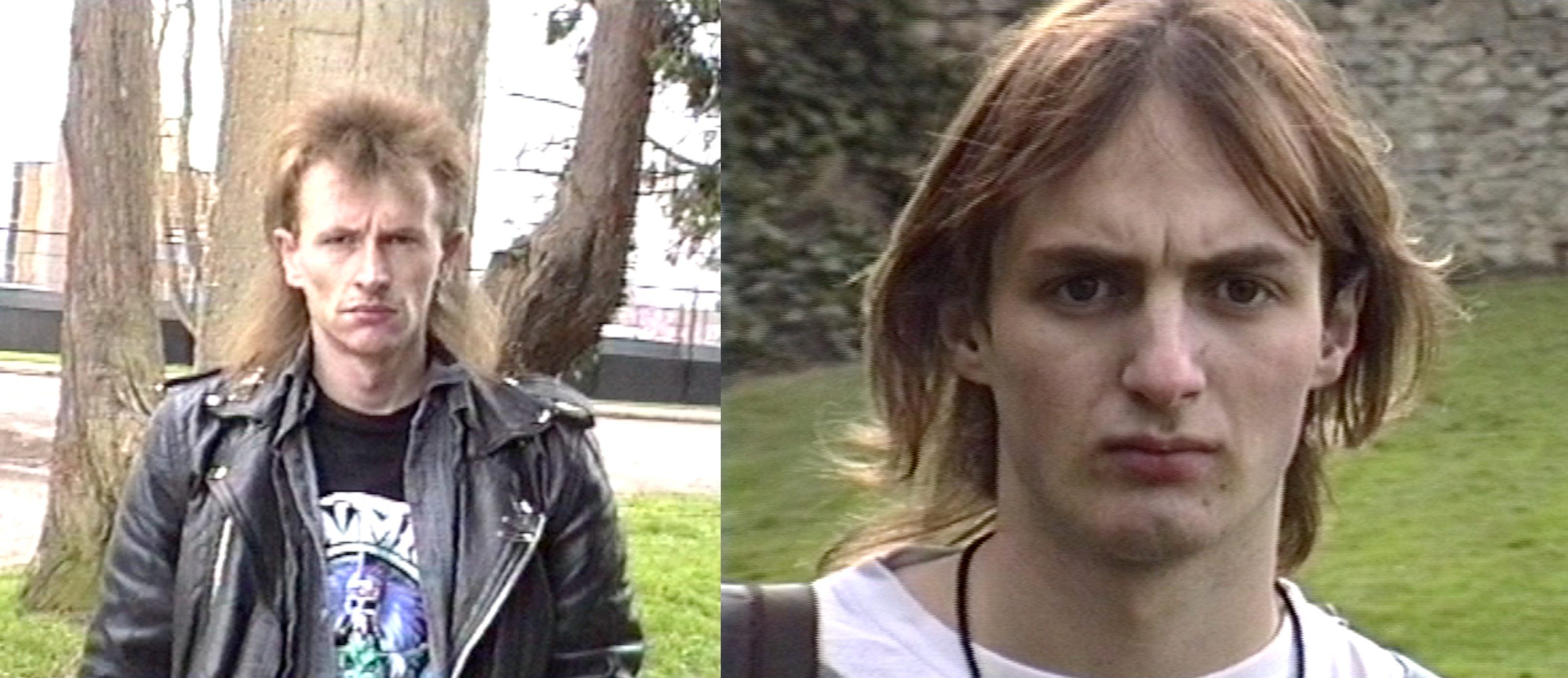
I then experimented with various AI models designed to generate an image of a person’s facial features, identical in likeness to a low-resolution reference image. The results were inconsistent on all platforms, with no logical pattern for success. I ended up using a platform called AI Consistent Characters, that offered very good watermarked generated images for free. All I had to do was remove the watermarks in photoshop. I then put these through Topaz Gigapixel AI, to generate more accurate skin and hair textures, high-definition faces and hair styles that I could then photoshop into the Chat GPT renditions of their bodies and clothing.
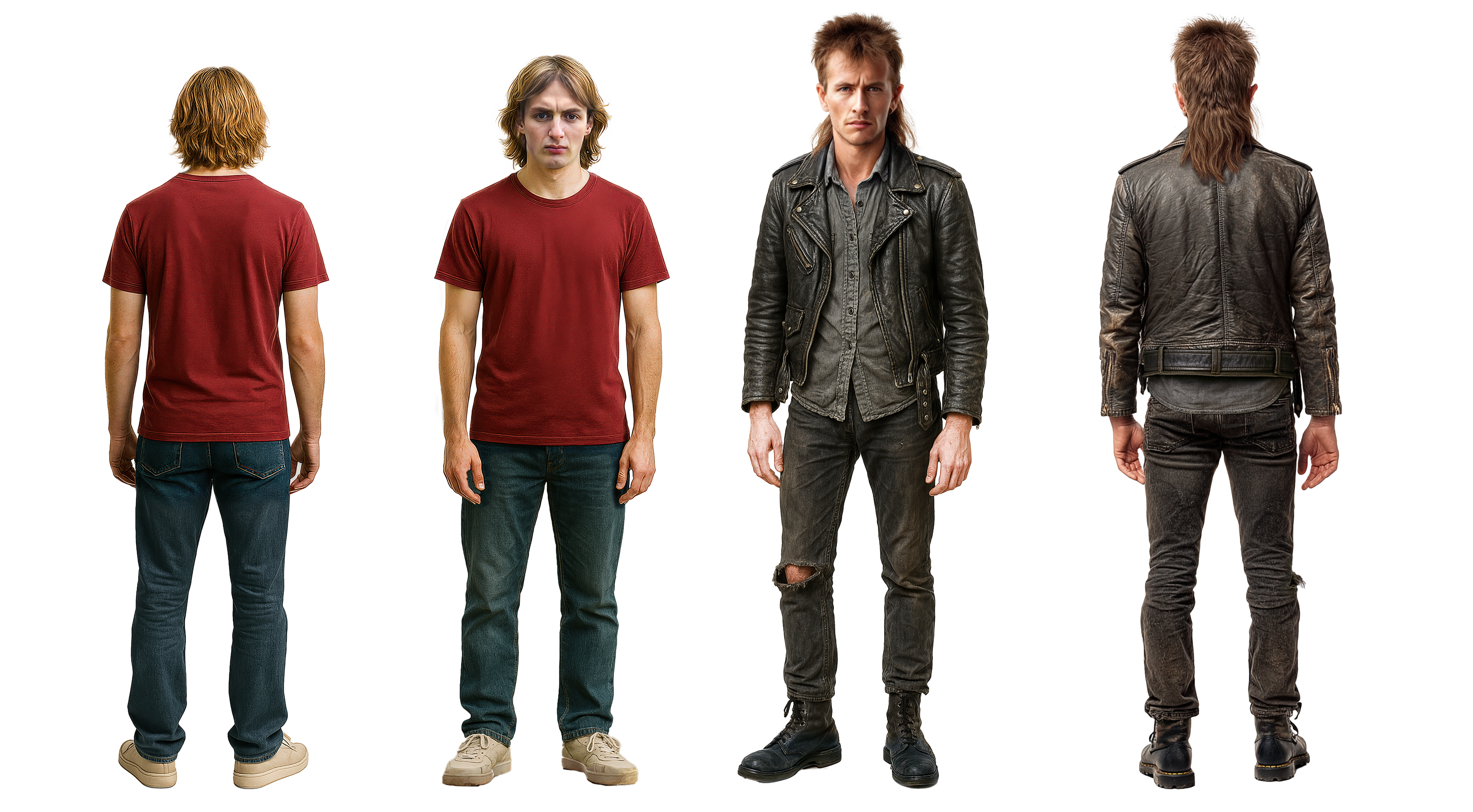
I then used Kling - an image to video AI platform to create the shots I needed using a prompt, a reference image of the location I created in MidJourney and the reference AI avatars of the actors above. If I needed them to speak, I’d create an opening frame in Photoshop, using various assets and upload this, along with the actor’s voice recording onto Hedra AI - a lipsync AI platform. I later used the newly released Nano Banana in Google AI Studio to get different angles on a scene.
To be clear, the results are by no means realistic. It all looks fake, in a way that is hard to articulate - just like the early days of CGI. There is no denying the technology is impressive and shows great potential, but there is an obvious deadness to the footage that lacks authenticity. It is certainly not at a level of controllability, believability or originality for me to want to use this technology for a present-day film project - at least not yet. AI is improving so fast though, so I’m sure you’ll soon be able to feed footage of real actor’s performances into AI, where it can embed them into a believable fantastical 4k world seamlessly, in far less time and far less cost than traditional production and VFX workflows.
Using AI in its current form, as a way to finish Dread, has been more satisfying than having to use a series of crudely drawn storyboards to fill in for the missing scenes. To me, it’s similar to how Dennis Muren and Joe Johnston used Star Wars figures to create a moving storyboard called an animatic to pre-visualise the speeder bike chase during the making of Return Of The Jedi, or how the BBC in 2017, used animation to create the missing scenes of an incomplete 1979 Dr Who story (written by Douglas Adams) called Shada.
The biggest frustration and difficulty I had with current AI technology is maintaining a character’s likeness. The AI also has a tendency to gradually make your characters generically better looking. In addition, AI kept misinterpreting my prompts, particularly when I use images of locations or characters that it has not generated itself.
For example, I wanted Quaid to remove Steven’s unconscious body from his living room, by picking him up under his arms and dragging him backwards, through the open doorway on the left of frame. I must have tried over a dozen prompts, but the closest I got was Quaid picking up Steven by his thigh and his neck, and dragging him out, which is a rather odd thing to do, but for now at least, it will have to suffice. I also found that increasingly, AI platforms censor your prompts for violence (and presumably nudity), which for genres like horror and thriller make it very difficult. You have to revise your words to say things like ‘spraying bright red paint across the walls’ instead of ‘arterial blood’ or ’slides the sleeping young man across the soil’ instead of ‘drags his unconscious body across the wasteland’
The subscription costs to use these tools has been relatively low. I’ve probably spent £60 in total, though some are free to use, partly because I don’t need the resolution any higher than Video 8 quality. However, if I were to use it for professional projects, I’d need a more affordable model/subscription that outputs a variety of low-quality renders for testing prompts, but can then re-generate selected individual shots in full HD/4K at a more acceptable premium price, that is charged ‘per second’ of approved usable footage.
Using AI to finish Dread has been a much longer and frustrating journey than I had originally anticipated, but at the same time, I’ve learned a lot about AI and its future potential for filmmaking. Ultimately though, I’m just thrilled it has enabled me to finally finish an early passion project that I was forced to abandon 33 years ago.
Time travelling fuels inspiration
Revisiting the film in such immersive detail over the last year, has brought back so many memories that have triggered my senses, momentarily transporting me back to the early 1990’s in such vivid clarity and realism, that it feels like a genuine form of time travel. To have this ability to time-travel back to my past, especially a time in which so many of my generation now yearn for, is a magical super-power I have been gifted with, and one I’m extremely grateful for.
One such trigger, was re-remembering that when I was about seventeen, I took a long arduous and costly journey via several trains, to get from Maidstone in Kent to Iver Heath in Slough, Buckinghamshire. I then had to walk several more miles from the station, to reach Pinewood Studios. At this age I was making my own videos, but I was still very much focussed on a career in special effects. My whole aim of the trip was to get some careers advice from Image Animation, the special effects company who were working on Clive Barker’s latest film adaptation Nightbreed. I was probably only there less than half an hour, but for me at the time, it was so exciting to see their workshop and be able to get practical answers to my questions, that careers advisors at school had only scoffed at.
It also reminded me of the valuable help and support I received from my old college mentor Paul Buck, whose advice led me to discover Dread in the first place. In turn, this memory led me to write my previous Substack piece on Mentors and to reconnect with Paul.
Such fond memories of naive unfettered ambition have also inspired me to revisit the short story of Dread and reconsider its screen adaptation from the perspective of a more professional and accomplished filmmaker that I am today. In doing so I realise my vision has not only become more lucid but that I still really, really want to write and direct a more faithful and impactful feature-length adaptation of this brilliant short story. As a result, I have already been making extensive notes.
My wake-up call.
Now, with the luxury of the internet and YouTube, I have had great pleasure over the last few months, researching as much as I can about the original short story and about Clive’s motivations for writing it. In doing so I have gained some useful insights from the interviews he gave around that time, that have helped me better understand Dread and Clive Barker’s unique way of seeing the world.
I also stumbled upon a recent and quite wonderful interview with him on stage at a recent horror convention, yet I was shocked by his appearance. In my mind, I expected him to look no different to when I saw him in Newcastle back in 1995, but somehow, he’s reached the ripe old age of 72 already!?
In addition, he appears physically to be quite fragile, having survived an acute toxic shock from a dental procedure in 2012 that put him in a coma. This experience clearly took its toll on his body, but thankfully his mind is still as sharp and passionate about fantasy horror as ever.
This was apparently the first public appearance he’d made in over ten years, a rare treat, especially as he said it would also be his last for a while, as he has five more books, he is eager to complete.
This stark realisation about his age has really upset me - it was a real wake up call. A reminder of how little time we all have on this amazing planet. So many years have already passed unnoticed, yet inside I feel no different to how I felt at nineteen (partly because I have such a vivid memory of my past that decades can feel like yesterday). I now worry that if I blink, I too will be in my seventies, but unlike Clive’s legacy of books, art and films, I still only have a modest (but respectable) collection of short films to my name.
However, until I am actually dead, there is always the possibility, however small, that I may still get an opportunity to finally direct a feature-length film and if that film happened to be Dread, then I’d be very happy indeed.
My vision for a feature-film adaptation of Clive Barker’s Dread.
For over thirty years I’ve wanted make Dread into a feature-film. I still have so many questions to ask Clive Barker about specific details in his short story that would inform my approach. I want to be completely faithful to the short story, using the unique qualities of film to successfully translate every detail into a complimentary piece of cinema that Clive can be truly proud of.
My adaptation would be set in the U.K, most likely in a historical northern city in England, on a university campus with the same feel as Liverpool University in the mid-eighties, when the story was written (ten years after Clive graduated from there and thirteen years before I graduated from Northumbria). The colour palette would be subdued, autumnal, with misty exteriors, smoke filled pubs and a university campus with sixties concrete style architecture. Most importantly, to have it set in the eighties, makes it void of smartphones and technology that over-complicate plots - a perfect era for characters like Quaid to pursue such twisted experiments without fear of being caught.
I’d expand the story further in places to accentuate what Clive Barker would often hint at in his writing, but also pay far more attention to the scenes he wrote, stretching time, to capture every nuanced detail, through attentive coverage of each scene, for maximum psychological immersion, tension and DREAD!
The film would be grounded in the period and culture of the mid-eighties, using very carefully chosen locations, that are cinematic yet affordable, choosing a resourceful cinematographer who can make the most of available light (Ben Fordesman for example, who shot Saint Maud) and creating many subtle visual effects myself (or perhaps even using AI), throughout the film, to enhance locations and add or remove specific period detail, to create genuine production value and atmospheric weight.
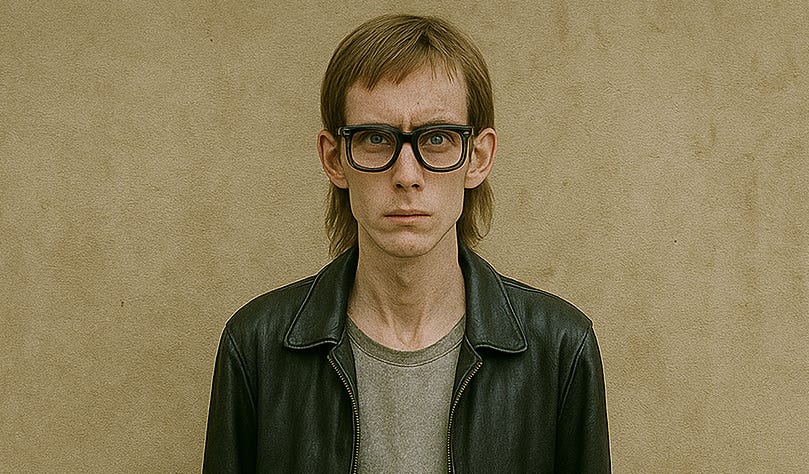
As for casting, I see all three of the main characters as looking slightly quirky rather than conventionally attractive. For me, it’s important for the audience to like and empathise with each character, because of their individual traits, not because they’re ‘good looking’.
Quaid would likely be the only ‘known name’ actor - a character actor of genuine talent (perhaps Lewis Gribben in a couple of years). Steven and Cheryl, because of their much younger age, would more likely be talented unknowns, but with enough life experience to grasp the real psychological aspects of the story, to deliver authentic performances.
If anyone reading this happens to know Clive Barker personally and is kind enough to send him a link to this post, then I’d be exceedingly grateful. To be fortunate enough to get an opportunity to engage in a deep conversation with Clive about Dread would be incredibly useful in the process of writing a feature-length screenplay adaptation. One I hope that could genuinely excite him enough to consider how such a project might get financed.
In the meantime, here is my long-overdue, completed 1992 adaptation. I hope that fans of the short story of Dread will appreciate the effort that went in to this adaptation, despite my inexperience and limitations at the time.
Please feel free to leave your thoughts and comments about the film below, as I’d be fascinated to hear what you liked or didn’t like about it.
You can view more of my short film work, including my more recent award-winning films on my website here at: www.delfilm.co.uk